
PLANTAE / PHANEROGAMAE / ANTHOPHYTA / ASTERALES / ASTERACEAE / CORYMBIOIDEAE / CORYMBIEAE / CORYMBIUM / ELSIAE

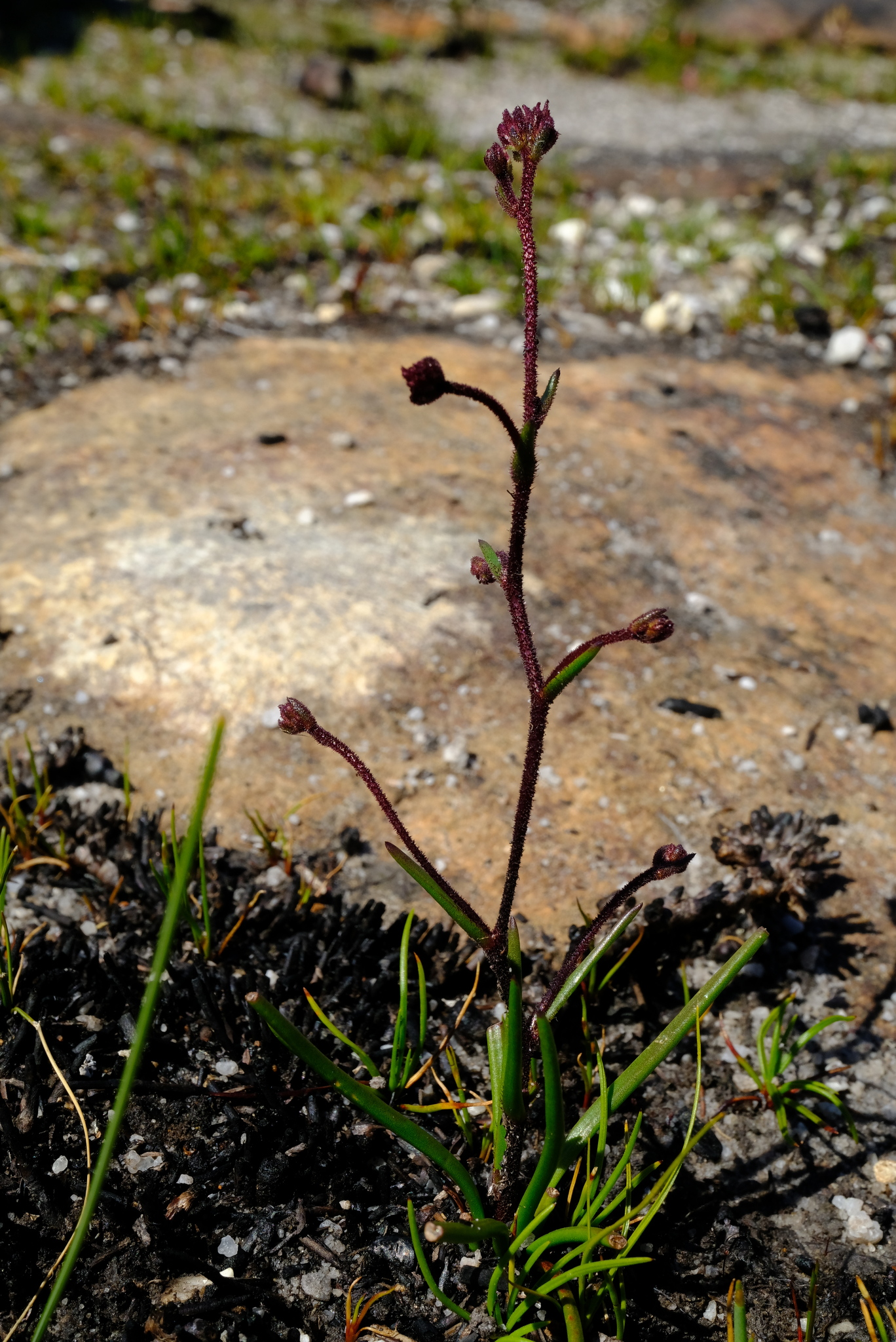
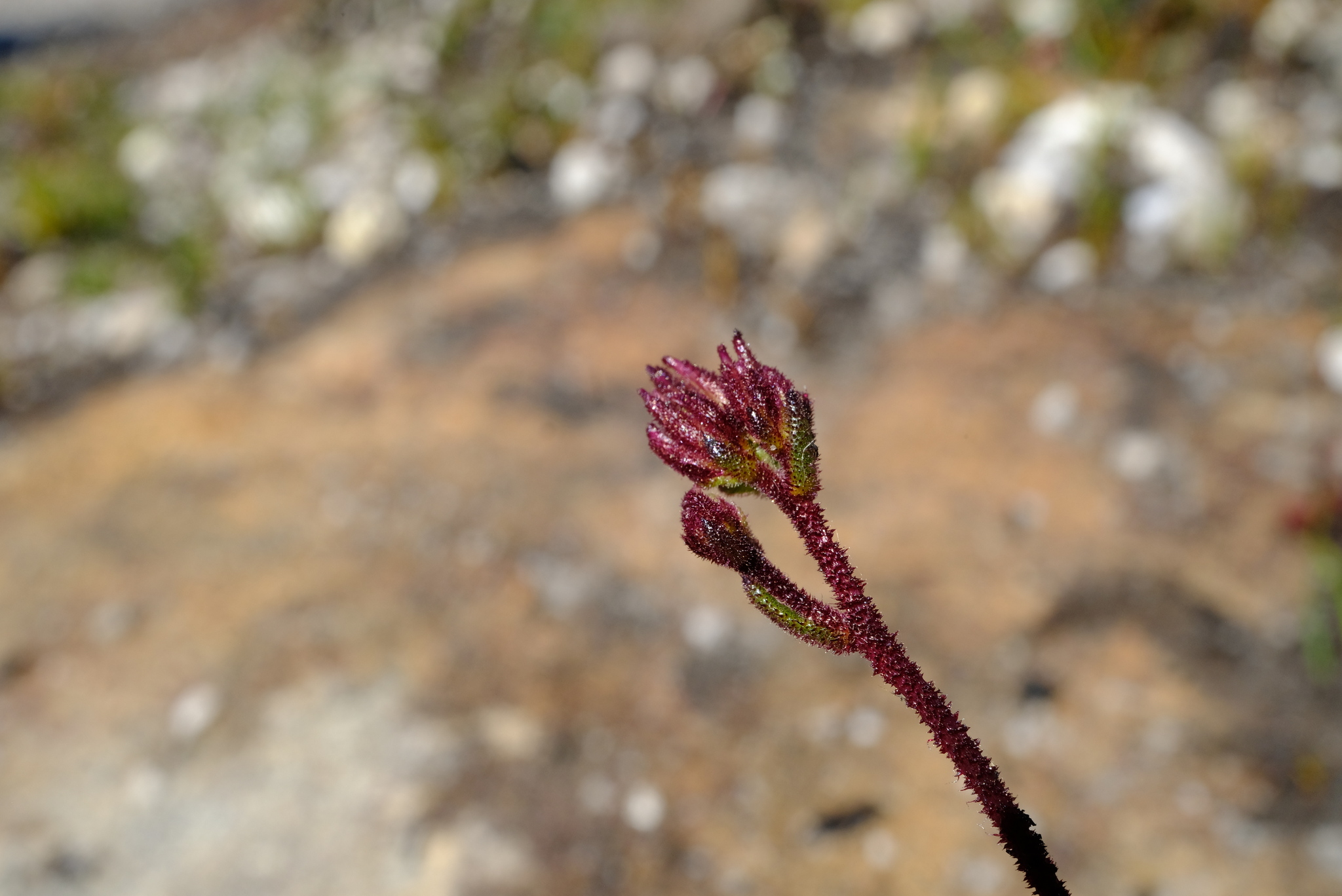
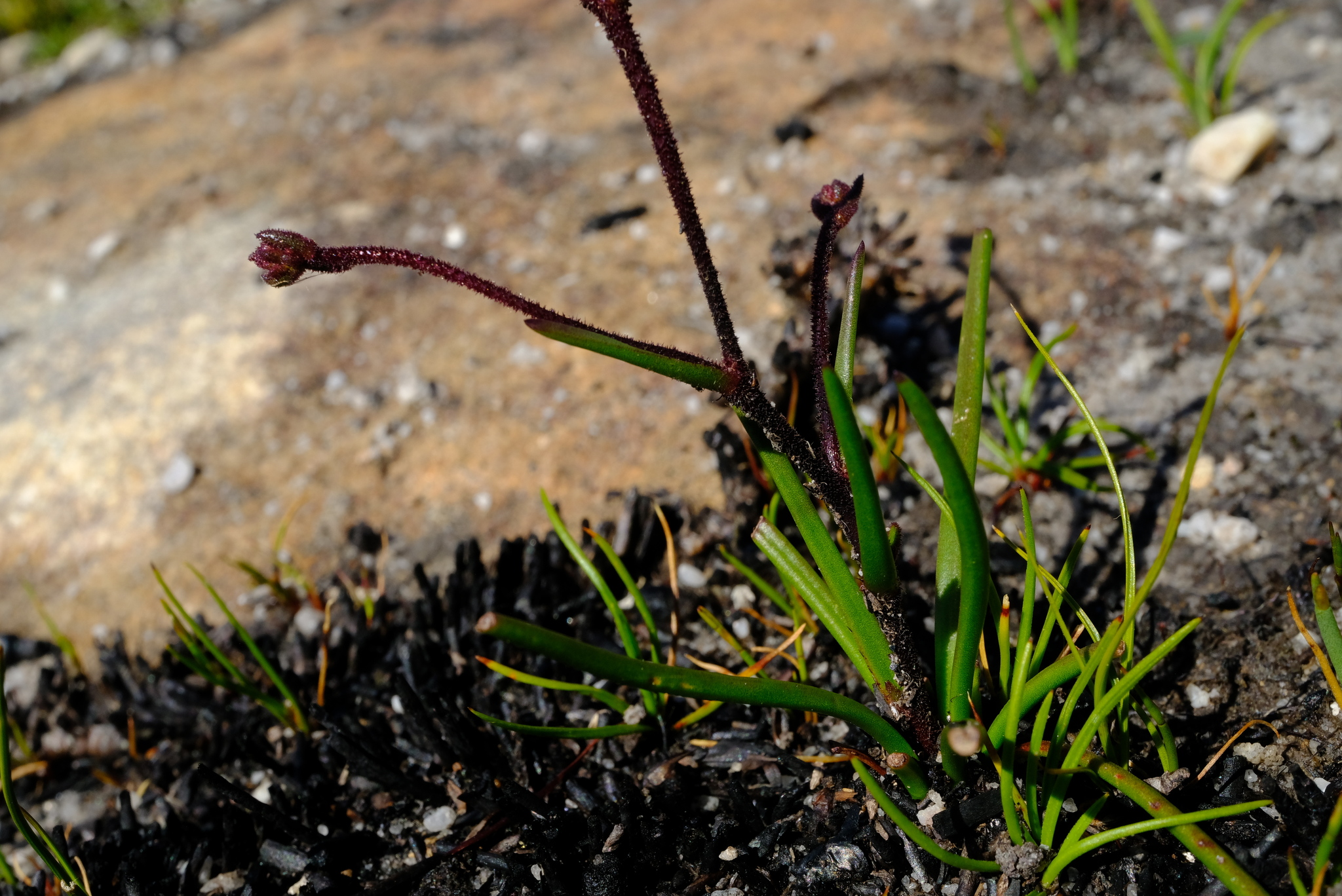
Similar to C. laxum subsp. laxum, but differing by the scabridity of the corymbophore, cauline leaves and bracts. Roots wiry. Leaves glabrous; blades narrowly linear to falcate, sometimes canaliculate, (80-)12()(-170) mm long, 1.5-2 mm broad, apex acute, base dilated, clasping with submembranous margins, silky hairs prominent, margins involute, veins not prominent; texture coriaceous becoming rugulose; cauline leaves scabrid, 5-65 mm long, 1-2 mm broad, clasping or half- clasping, diminising in size upwards. Corymbophore round to angular in cross section, scabrid, glandularly muricated, (150-)190(-255) mm long, 1.5-2 mm in diameter, branching from corymbophore dichotomously. Heads distinctly pedunculate or with a very short penduncle ca. 1 mm or sessile, arranged in a panicle. Involucral bracts scabrid, glandularly muricate, 2-3 smaller bracts subtending 2 upper bracts; upper bracts (6.5-)9.5(-12) mm, apex trifid or fimbriate, purple or greenish purple. Flowers mauve, pedicel present. Petals oblong elliptic (4.8-)6.8(8.3) mm long, ca. 2 mm broad; corolla tube 3-5 mm long. Anthers ca. 4.2 mm including base. Ovary hirsute, style branches long obtuse. Cypsela ca. 5 mm long 1.5 mm broad, linear to elliptic. Pappus coroniform at base, fibriate, bristles many 1 mm long. From: Weitz, FM. 1989. A revision of the genus Corymbium L. (Asteraceae). S. African J. Bot. 55: 598-629. [Copyright held by the South African Association of Botanists (1989); http://www.sciencedirect.com/science/journal/02546299] [CC BY]
Tufted perennial to 25 cm with scabrid stems. Leaves filiform with involute margins, smooth, silky at base. Flower heads drooping, in lax panicles, mauve or white, bracts scabrid. From: Manning, JC; Goldblatt, P. 2012. Asteraceae: Corymbium L. In: J Manning & P Goldblatt (eds), Plants of the Greater Cape Floristic Region 1: The Core Cape flora. Strelitzia 29: 364-365. South African National Biodiversity Institute, Pretoria. [CC BY]
Diagnostic features: Radical leaves glabrous; blades narrowly linear to falcate, sometimes chanelled, margins involute. Corymbophore scabrid. Heads distinctly pedunculate or with a short peduncle or sessile, arranged in a panicle. Involucral bracts scabrid, trifid. Flowers mauve. Ovary hirsute. C. elsiae is closely allied to C. laxum differing in scabridity of the corymbophore, cauline leaves and bracts, and with cellulosic leaf epidemal cell walls. There is a considerable variation in the arrangement of heads in the conflorescence of C. elsiae. It is either distinctly pedunculate or with a very short peduncle or sessile. The conflorescence of certain populations may vary from a simple to a much-branched panicle with pedunculated or sessile heads. Therefore, pedunculated heads is not a constant character for this species as in C. laxum. Although local races may appear distinct, continuous variation of the corymbophore morphology within a race does not warrant the subdivision of this species into infraspecific taxa. From: Weitz, FM. 1989. A revision of the genus Corymbium L. (Asteraceae). S. African J. Bot. 55: 598-629. [Copyright held by the South African Association of Botanists (1989); http://www.sciencedirect.com/science/journal/02546299] [CC BY]
Populations occur on steep rocky slopes especially in crevices, in shallow soil derived from Table Mountain Sandstone. This species usually grows in association with low-growing Restionaceous Fynbos. From: Weitz, FM. 1989. A revision of the genus Corymbium L. (Asteraceae). S. African J. Bot. 55: 598-629. [Copyright held by the South African Association of Botanists (1989); http://www.sciencedirect.com/science/journal/02546299] [CC BY]
upper slopes. From: Manning, JC; Goldblatt, P. 2012. Asteraceae: Corymbium L. In: J Manning & P Goldblatt (eds), Plants of the Greater Cape Floristic Region 1: The Core Cape flora. Strelitzia 29: 364-365. South African National Biodiversity Institute, Pretoria. [CC BY]
C. elsiae is a high-altitude species with a narrow distribution, from Ceres Peak to Bain's Kloof. From: Weitz, FM. 1989. A revision of the genus Corymbium L. (Asteraceae). S. African J. Bot. 55: 598-629. [Copyright held by the South African Association of Botanists (1989); http://www.sciencedirect.com/science/journal/02546299] [CC BY]
Ceres to Bain's Kloof. From: Manning, JC; Goldblatt, P. 2012. Asteraceae: Corymbium L. In: J Manning & P Goldblatt (eds), Plants of the Greater Cape Floristic Region 1: The Core Cape flora. Strelitzia 29: 364-365. South African National Biodiversity Institute, Pretoria. [CC BY]
December
900 to 1500 m
This map contains point-based occurrences at different locations
Occurrence in the Flora of Southern Africa (FSA) countries and South African provinces. Residence status indicates if a taxon is indigenous, endemic, naturalised or invasive in a specific region. This data is based on specimen records and literature
FSA
SA
BOT
NAM
ESW
LES
WC
EC
NC
FS
GA
KZN
LP
MP
NW
Absent
Indigenous
Endemic
Naturalised
Invasive

Names and Sources
Classification
KINGDOM Plantae
SUBKINGDOM Phanerogamae
PHYLUM Anthophyta
ORDER Asterales
FAMILY Asteraceae
SUBFAMILY Corymbioideae
TRIBE Corymbieae
GENUS Corymbium
SPECIES elsiae
3 results for Corymbium elsiae Weitz
Barcode: NBG0023855-0 Collector(s) & number: Guthrie, F, s.n. | 1892-1-
South Africa, Western Cape, Upper valley above Ceres.
General notes: Grassy slope on left before sloping the water.
Data Resource: BODATSA View record
Barcode: PRE0747083-0 Collector(s) & number: Weitz, FM, 333 | 1982-2-28
South Africa, Western Cape, CERES DIST; CERES PEAK; ON DRY EASTERN SLOPE
Data Resource: BODATSA View record
This map contains point-based occurrences at different locations
2012
SERIES CHAPTER
Asteraceae: Corymbium L. Manning, JC; Goldblatt, PIn: J Manning & P Goldblatt (eds), Plants of the Greater Cape Floristic Region 1: The Core Cape flora. Strelitzia 29: 364-365
South African National Biodiversity Institute, Pretoria
1989
PERIODICAL/JOURNAL
A revision of the genus Corymbium L. (Asteraceae) Weitz, FMSouth African Journal of Botany 55: 598-629
No results found for Corymbium elsiae Weitz
Status and criteria
LC
Assessor(s)
Plantae Coordinator
| Part(s) of plant used | Use(s) | Reference |
|---|
Coming soon...


