PLANTAE / PHANEROGAMAE / ANTHOPHYTA / LAMIALES / OROBANCHACEAE / GRADERIA / LINEARIFOLIA

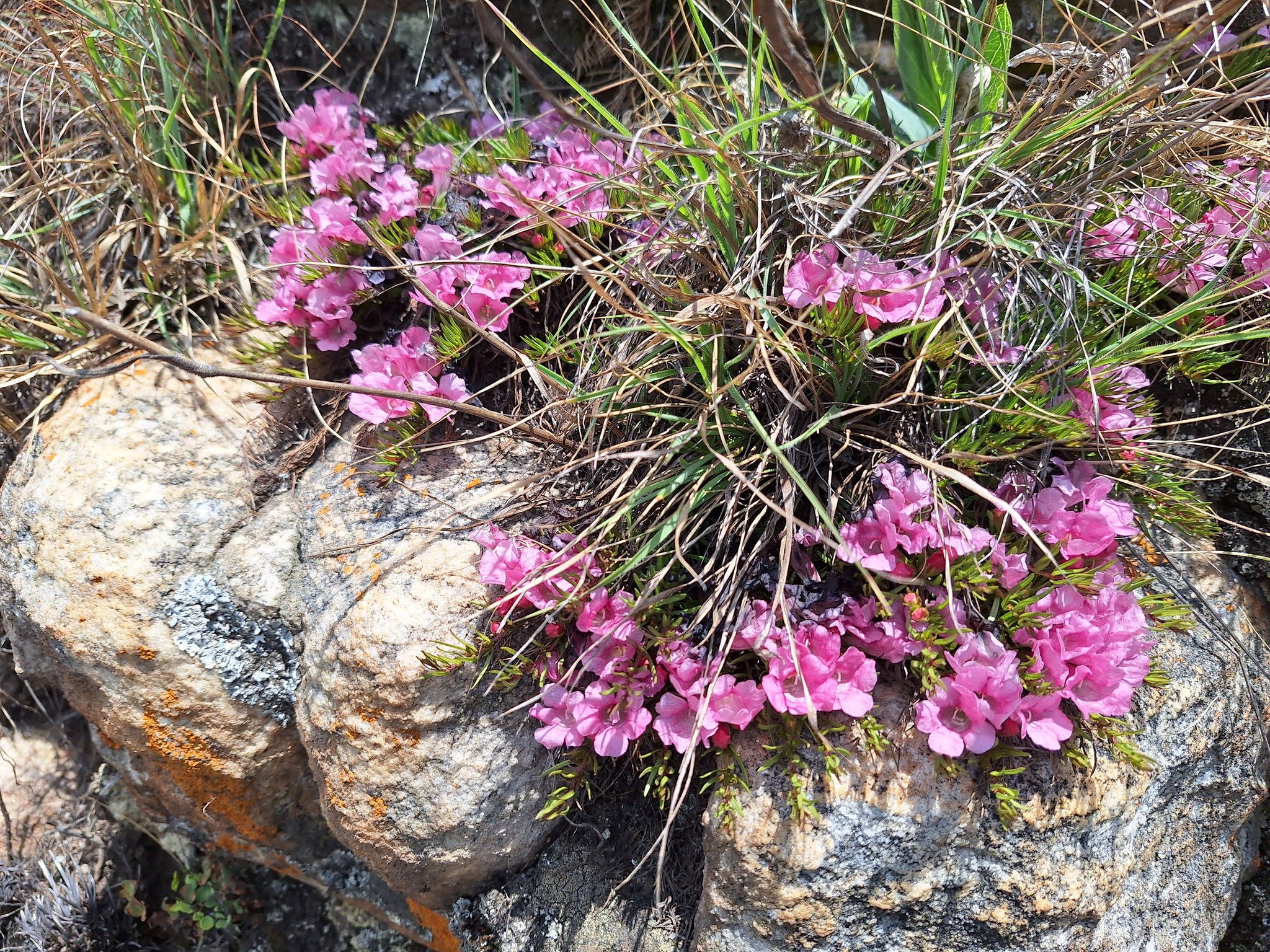
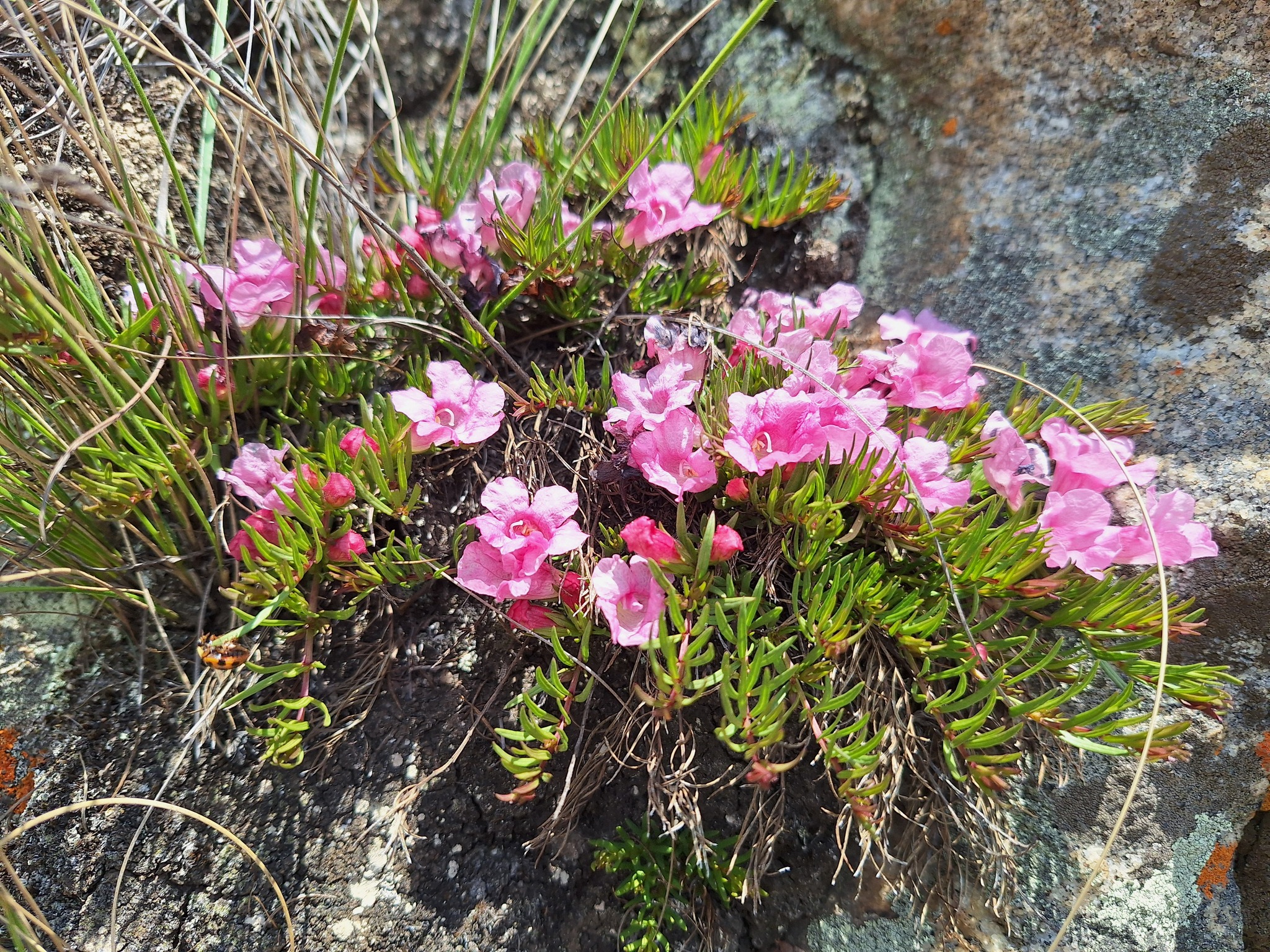
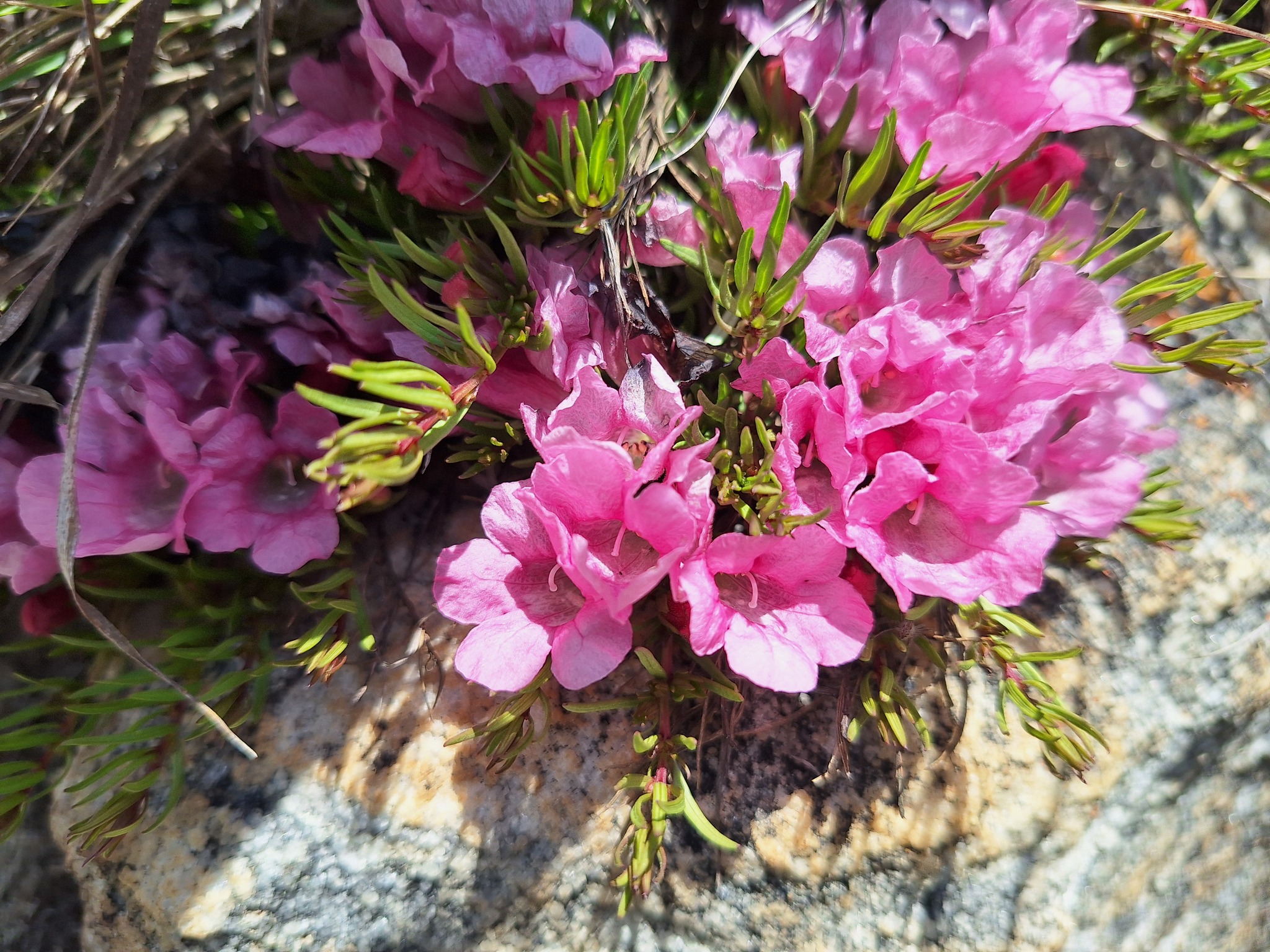
A compact, semi-woody, perennial herb with a thin, woody rootstock, branching from the base, forming small cushions 7-14 cm in diameter. Stems mainly prostrate, glabrous, slender, somewhat quadrangular, 4-11 cm long. Leaves crowded, opposite or subopposite or in whorls of 3 or 4, secund, erect, glabrous, linear, scarcely narrowed at the base, 1.0-1.6 cm long and up to 1 mm broad, drying blackish; margin narrowly revolute, entire; median nerve prominent below, slightly impressed above. Flowers crowded towards the centre of the plant, solitary in the leaf axil; pedicels 2-3 mm long; bracteoles 2, linear, erect or subspreading, 4-5 mm long, inserted at or below the base of the calyx. Calyx funnel-shaped, equally 5-toothed, 10-nerved, 6-7 mm long at flowering stage, glabrous; tube 3-3-5 mm long; teeth ovate-triangular, acute, 3-3.5 mm long, each with a distinct median nerve. Corolla funnel-shaped, pink to rose-red, drying black, minutely and sparsely puberulous without, 1.6-2 cm long and 1.4-1.8 cm wide at the mouth; tube 1.1-1.3 cm long; limb somewhat spreading, 5-lobed; lobes subequal, broadly rounded, 5-7 mm long and 5-7 mm broad. Stamens included, didynamous; filaments slender, minutely puberulous below, the two shorter 4 mm long attached 5 mm above the base of the corolla tube, the two longer 7-8 mm long attached 2-2.5 mm above the base of the corolla tube; anthers 2-celled; cells diverging, oblong-falcate, 2 mm long, mucronulate, one cell narrower than the other Ovary ovoid, compressed, glabrous, 2 mm long, 2-celled; ovules numerous; style filiform, glabrous, 1-2 cm long, exceeding the stamens, slightly exserted; stigma somewhat thickened, minutely bifid. Capsule included in the persistent calyx, woody, compressed, widening obliquely towards the apex, obscurely bilobed, one lobe acute with often the base of the style persisting, the other lobe rounded, dehiscing along the apex. Seed numerous, oblong, 1.25 mm long; testa reticulate. From: Codd, LEW. 1964. Scrophulariaceae. Bothalia 8(2): 176-177. [https://doi.org/10.4102/abc.v40i2.210] [CC BY]
Compact, semiwoody perennial herb. Rootstock thin, woody, branching from base, forming small cushions 70-140 mm in diameter. Leaves crowded, linear, 10-16 x 1 mm, drying black. Filaments minutely pu-berulous below. Flowers pink to rose-red. From: Retief, E; Herman, PPJ. 1997. Plants of the northern provinces of South Africa: Keys and diagnostic characters. Strelitzia 6: 1-681. National Botanical Institute, Pretoria. [CC BY]
Readily distinguished from the other species by the dwarf, compact habit and the narrow, linear, glabrous leaves. The flowers are smaller and, because of the short internodes, appear close together near the centre of the small cushions. The plants are inconspicuous and are easily overlooked except during their short flowering period in spring. From: Codd, LEW. 1964. Scrophulariaceae. Bothalia 8(2): 176-177. [https://doi.org/10.4102/abc.v40i2.210] [CC BY]
Grows in sparse mountain grassland on poor, gravelly, quartzitic soil. From: Codd, LEW. 1964. Scrophulariaceae. Bothalia 8(2): 176-177. [https://doi.org/10.4102/abc.v40i2.210] [CC BY]
Shallow sandy soil among quartzite rocks. From: Retief, E; Herman, PPJ. 1997. Plants of the northern provinces of South Africa: Keys and diagnostic characters. Strelitzia 6: 1-681. National Botanical Institute, Pretoria. [CC BY]
Known only from the top of the Steenkampsberg, on the road from Lydenburg to Draaikraal. From: Codd, LEW. 1964. Scrophulariaceae. Bothalia 8(2): 176-177. [https://doi.org/10.4102/abc.v40i2.210] [CC BY]
October
0 to 2255 m
This map contains point-based occurrences at different locations
Occurrence in the Flora of Southern Africa (FSA) countries and South African provinces. Residence status indicates if a taxon is indigenous, endemic, naturalised or invasive in a specific region. This data is based on specimen records and literature
FSA
SA
BOT
NAM
ESW
LES
WC
EC
NC
FS
GA
KZN
LP
MP
NW
Absent
Indigenous
Endemic
Naturalised
Invasive
Names and Sources
Classification
KINGDOM Plantae
SUBKINGDOM Phanerogamae
PHYLUM Anthophyta
ORDER Lamiales
FAMILY Orobanchaceae
GENUS Graderia
SPECIES linearifolia
6 results for Graderia linearifolia Codd
Barcode: PRE0860380-0 Collector(s) & number: Burrows, JE, 12244 | 2011-4-9
South Africa, Mpumalanga, Lydenburg District. Portion 1 of farm Pardeplaats 91JT, ±700 m SSE of dam/house.
Data Resource: BODATSA View record
Barcode: PRE0167980-0 Collector(s) & number: Codd, LEW, 9855 | 1958-3-11
South Africa, Mpumalanga, LYDENBURG DIST.; DRAAIKRAAL; 7.5 MI. E. OF DRAAIKRAAL ON TOP OF STEENKAMPSBERG
Data Resource: BODATSA View record
Barcode: PRE0590936-0 Collector(s) & number: Codd, LEW, 9832 | 1957-10-18
South Africa, Mpumalanga, LYDENBURG DIST.; ON TOP OF STEENKAMPSBERG ON ROAD TO DRAAIKRAAL
Data Resource: BODATSA View record
Barcode: PRE0167978-0 Collector(s) & number: Codd, LEW, 9832 | 1957-10-18
South Africa, Mpumalanga, LYDENBURG DIST.; ON TOP OF STEENKAMPSBERG ON ROAD TO DRAAIKRAAL
Data Resource: BODATSA View record
Barcode: PRE1004593-0 Collector(s) & number: De Castro, A, 1755 | 2020-10-23
South Africa, Mpumalanga, Boogendal Mine Property. Farm De Burg 76 JT.
Data Resource: BODATSA View record
This map contains point-based occurrences at different locations
1997
SERIES
Plants of the northern provinces of South Africa: Keys and diagnostic characters Retief, E; Herman, PPJStrelitzia 6: 1-681
National Botanical Institute, Pretoria
1964
No results found for Graderia linearifolia Codd
Status and criteria
VU
Assessor(s)
Plantae Coordinator
JOURNAL ARTICLE
Chodat, R. 1913. Polygalalaceae africanae IV. Botanische Jahrbücher für Systematik, Pflanzengeschichte und Pflanzengeographie. 48:309-336
JOURNAL ARTICLE
Christenhusz, M.J., Brockington, S.F., Christin, P.-A. and Sage, R.F. 2014. On the disintegration of Molluginaceae: a new genus and family (Kewa, Kewaceae) segregated from Hypertelis, and placement of Macarthuria in Macarthuriaceae. Phytotaxa. 181:238-242
JOURNAL ARTICLE
Christenhusz, M.J. and Byng, J.W. 2016. The number of known plants species in the world and its annual increase. Phytotaxa. 261:201-217
JOURNAL ARTICLE
Christian, C.E. 2001. Consequences of a biological invasion reveal the importance of mutualism for plant communities. Nature. 413:635-639
| Part(s) of plant used | Use(s) | Reference |
|---|
Coming soon...