ANIMALIA / CHORDATA / REPTILIA / SQUAMATA / CHAMAELEONIDAE / BRADYPODION / NEMORALE
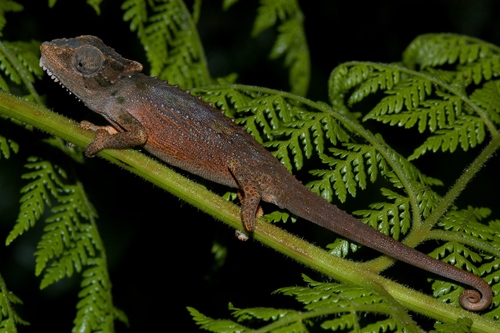
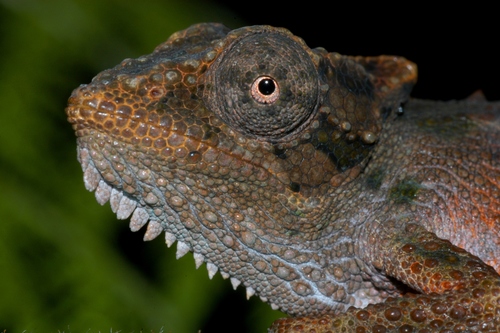
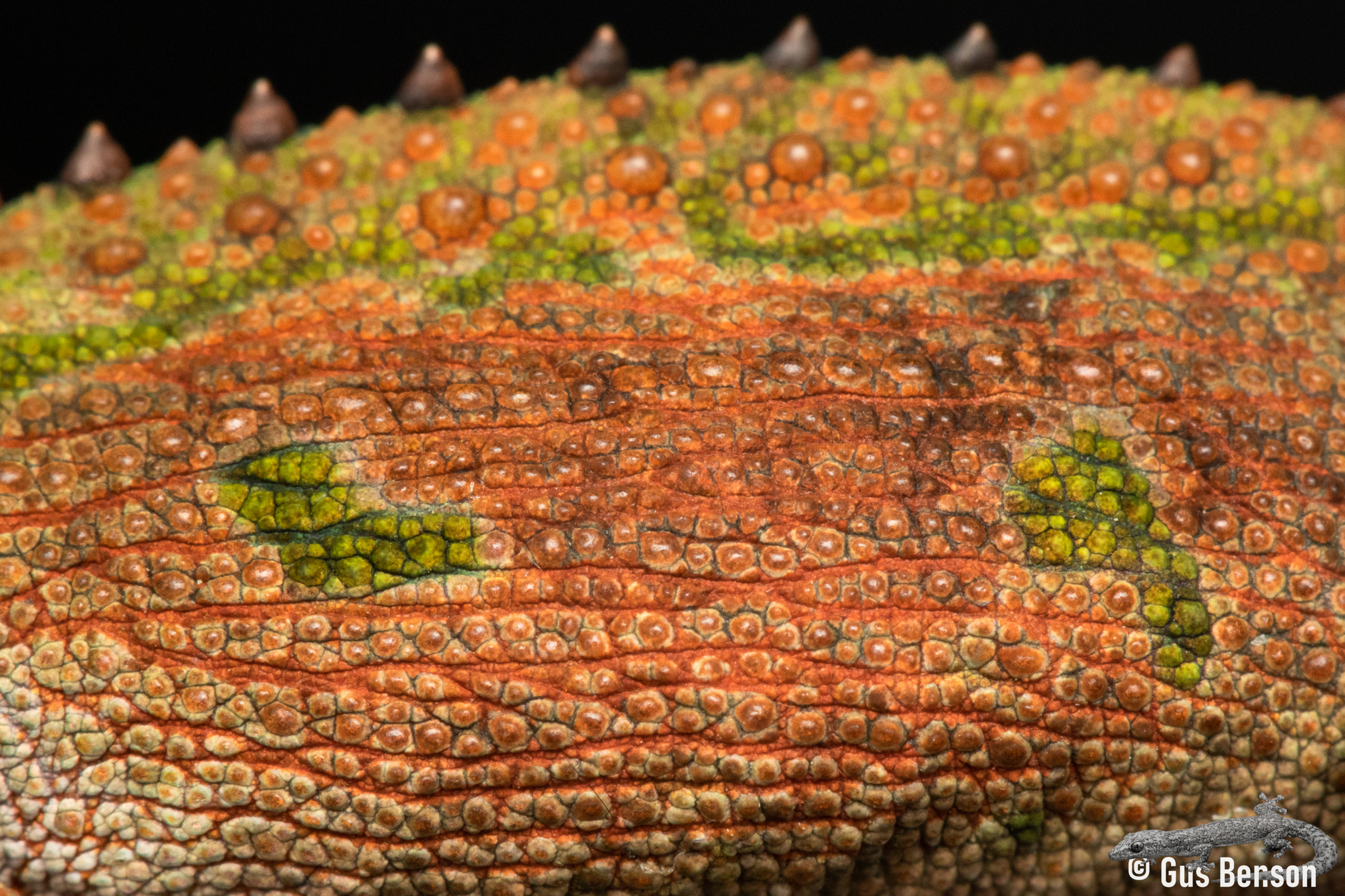
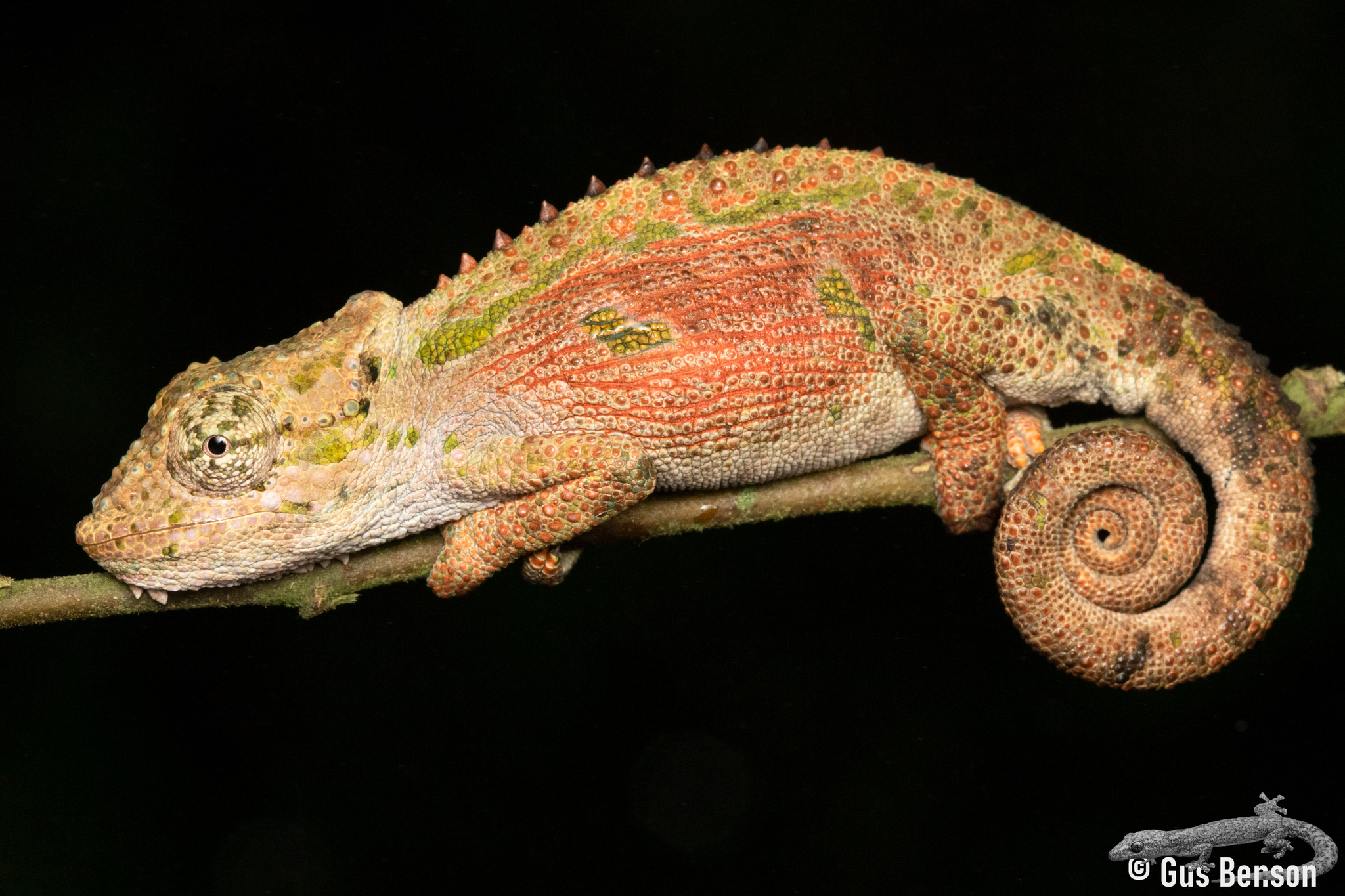
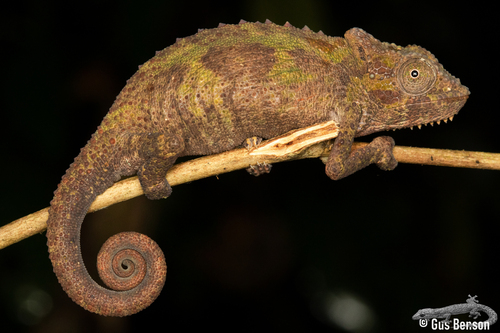
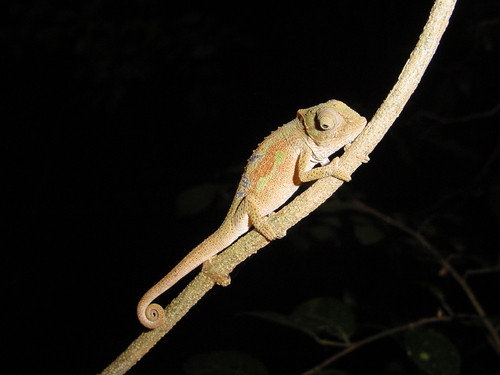
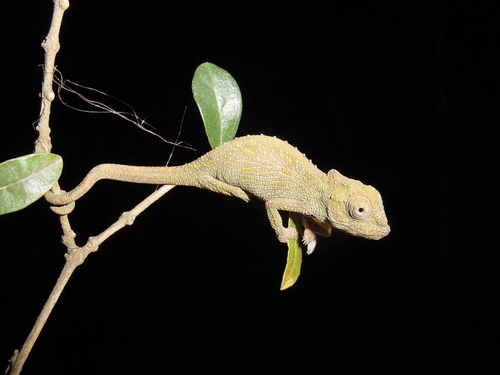
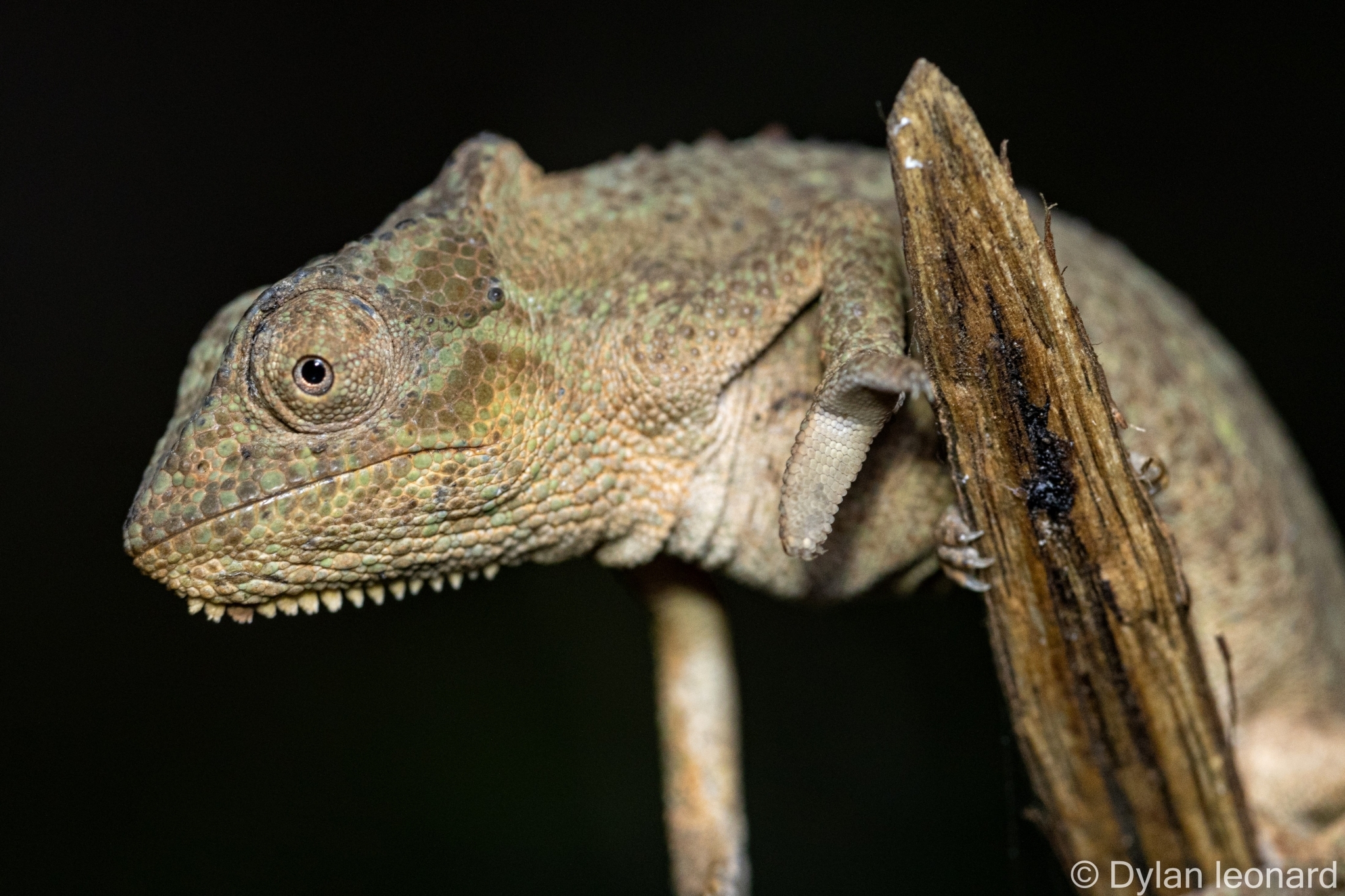
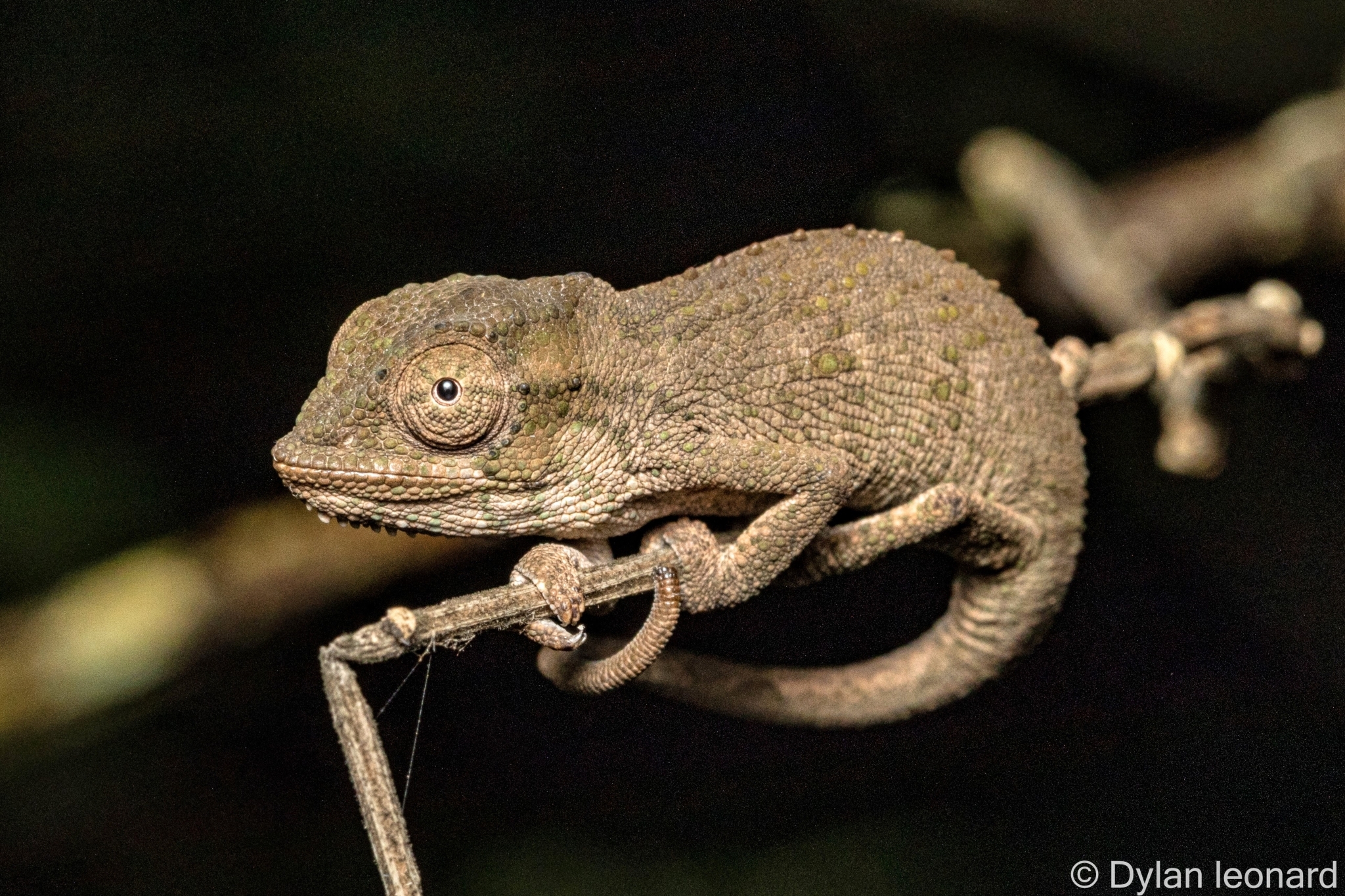
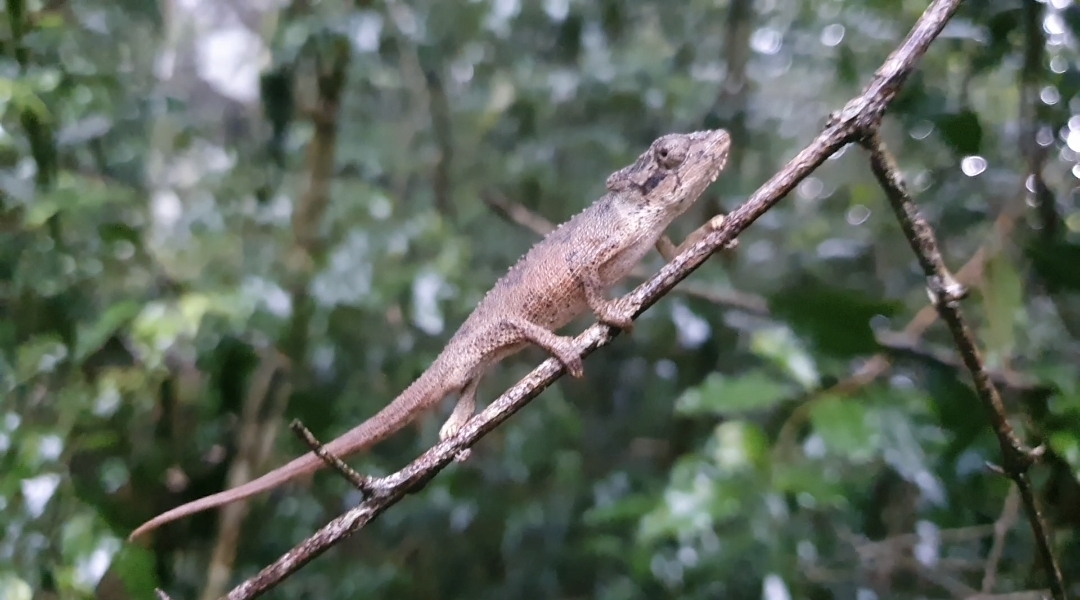
Raw (1978) described this species as follows: Angle of snout relatively sharp; distance from tip of snout to anterior border of orbit approximately 1J times diameter of eye. Casque moderately elevated, recurved, posteriorly elongated and projecting. Cranial crests moderately distinct, tubercles not horn-coloured. Distance between commissure of mouth and posterior extremity of casque equal to mouth length. Temporal scales moderate, flat and unequal. Scales on body granular, finely heterogeneous and without any greatly enlarged flattened tubercles. A band of irregularly scattered very slightly enlarged tubercles below dorsal crest on upper flank. An indistinct and irregular row of slightly larger tubercles along flank just dorsal to midline. Other body scales small, granular, arranged in longitudinal series of varying width and separated by irregular horizontal grooves of finer skin. Dorsal crest well developed, extending on to tail and comprising an irregular series of laterally flattened, enlarged, triangularly pointed scales. (Some paratypes with the dorsal crest less distinct and not reaching the sacral region). Dorsal crest count 27 (range 10-29). Gular crest scaly, moderately developed, lobes longer than broad. Gular crest count 11 (range 8-20). Limbs with sparsely scattered slightly enlarged tubercles. Tail-length less than that of head and body. Colour in life: Nkandla sub-adult male: brown with irregular greenish blotches, mainly along upper flank but also forming irregular islands of colour on the lower flank. Slightly enlarged tubercles along middle of flank orange; tubercles of dorsal crest red dish brown. Skin on flanks arranged into longitudinal pattern with intervening grooves orange. Scattered enlarged tubercles on flanks, limbs and tail orange. Throat grooves greyish white and eyelids with thin greenish lines radiating outward from eye. Size: Holotype: head length 23; mouth length 15; snout-vent length 80; tail length 65 mm. Hemipenes: Everted left hemipenis of LR 880 (sub-adult) short, broadening towards apex. Four inward curving apical structures grouped two anteriorly, two posteriorly; outermost of each pair largest; outer, distal edges denticulate. Basal surface smoothly calyculate. Sulcus spermaticus passes along base of organ posteriorly before turning sharply lengthwise, passing between enlarged fleshy lips to end in smooth area on outer side of organ. Right hemipenis mirror image of left with sulcus at posterior edge.
This information was extracted from Raw (1978): A moderate size dwarf chameleon with finely heterogeneous granular scales. Casque moderately elevated, recurved and posteriorly projecting. Cranial crests moderately developed and distinct but not swollen or horn-coloured. Gular crests scaly, moderately developed, longer than broad. Throat region pigmented, not white nor with black lines. Dorsal crest usually distinct and continuing on to tail, and with flattened tubercles on flanks. Scales on flanks interrupted by longitudinal grooves of smoother skin, often red or orange in colour. Tail shorter than head and body.
Type locality: Qudeni forest, Zululand, S. Africa Holotype: NMSA (also as NMP or NM) 1474 (Natal Museum collection, Pietermaritzburg) Holotype: private collection, LRG Raw number LR900 collected by FL Farquharson, MN Harris and LRG Raw on 3 April 1977. This is presumably an immature specimen but no obviously adult specimens of this taxon have yet been collected [nkandlae]
This information was extracted from Tolley et al. (2023): Originally described from Qudeni and Nkandla forests (Raw 1978), although the Nkandla subpopulation was later described as B. nkandlae (Raw and Brothers, 2008). This was based on juvenile specimens, which lacked clear diagnostic morphological differences with which to distinguish it from the Qudeni subpopulation. Phylogenetic studies showed a lack of divergence between chameleons from these two forests and as a result B. nkandlae was referred to synonymy of B. nemorale (Tilbury and Tolley, 2009). The species is now known from three forest patches, which has been confirmed by genetic studies (K.A. Tolley, unpubl. data 2019). There is also a morphologically distinct but closely related undescribed species near Greytown.
South Africa
This species is endemic to three small forest patches in KwaZulu-Natal province, South Africa (Tolley and Burger 2007; Tilbury 2018). Until recently, this chameleon was only known from Qudeni and Nkandla forests but now has been confirmed from Ntunjambili Forest near the town of Ntunjambili [Kranskop] (Tolley et al., 2023).
All Bradypodion are very slow-moving animals, walking and climbing, with at least one foot touching a surface (e.g., branch) at all times during movement. Their prehensile tail assists in locomotion by providing stability and balance when they move vertically through vegetation and between gap areas. Their fused digits on their feet aids in grasping branches without slipping (Tolley and Burger, 2007). B. nemorale is arboreal, spending most of its time in trees or shrubs, but will occasionally move on the ground between shrubs.
Carnivore - Insectivore (insect-eating)
All Bradypodion species are primarily insectivores, using their long, projectile tongue to catch small insects like flies, grasshoppers, crickets, insect larvae and other small invertebrates. Water is required regularly and is licked from dew or raindrops on foliage (Tolley and Burger, 2007).
As with other Bradypodion species, B. nemorale has aseasonal reproduction and is ovoviviparous, capable of birthing 5-15 babies per litter and several litters maybe produced per years (Tolley and Burger, 2007). Females may mate with several males and are thought to store sperm (Tolley et al., 2014). Fertilized eggs take several months to develop, and babies have rapid growth, reaching maturity in about nine months (Tolley and Burger, 2007). No parental care is given.
All Bradypodion species are active during the day. Like all Bradypodion, these chameleons have the ability to change colour as a physiological response to external conditions such as light and temperature, when sick, stressed, males displaying when courting females, as a defense mechanism and camouflage (Tolley and Burger, 2007).
Forest
This map contains point-based occurrences at different locations
Occurrence in African countries and South African provinces. Residence status indicates if a taxon is indigenous, endemic, or alien in a specific region. This data is based on specimen records and literature.
FSA
SA
BOT
NAM
ESW
LES
WC
EC
NC
FS
GA
KZN
LP
MP
NW
Absent
Indigenous
Endemic
Naturalised
Invasive
Names and Sources
| Common Name | Language |
|---|---|
| Qudeni Dwarf Chameleon | En |
| Qudeni Dwergverkleurmannetjie | En |
| Zululand Dwarf Chameleon | En |
Classification
KINGDOM Animalia
PHYLUM Chordata
CLASS Reptilia
ORDER Squamata
FAMILY Chamaeleonidae
GENUS Bradypodion
SPECIES nemorale
No results found for Bradypodion nemorale Raw, 1978
There is no known utilisation or trade of this species (UNEP-WCMC 2020).
9 results for Bradypodion nemorale Raw, 1978
This map contains point-based occurrences at different locations
1978
JOURNAL ARTICLE
A further new dwarf chameleon from Natal, South Africa (Sauria: Chamaeleonidae).Raw, L.. 1978. A further new dwarf chameleon from Natal, South Africa (Sauria: Chamaeleonidae). Vol. 11(15) pp.265-269.
2009
JOURNAL ARTICLE
A new species of dwarf chameleon (Sauria; Chamaeleonidae, Bradypodion Fitzinger) from KwaZulu Natal South Africa with notes on recent climatic shifts and their influence on speciation in the genusTilbury, C., Tolley, K.. 2009. A new species of dwarf chameleon (Sauria; Chamaeleonidae, Bradypodion Fitzinger) from KwaZulu Natal South Africa with notes on recent climatic shifts and their influence on speciation in the genus Vol. 2226 pp.43–57.
2007
BOOK
Chameleons of Southern AfricaBurger, M., Tolley, K.. 2007. Chameleons of Southern Africa. Cape Town. Struik Publishers.
2020
WEBSITE
CITES Trade DatabaseUNEP-WCMC, . 2020. CITES Trade Database. https:// trade.cites.org/. (Accessed: 15 September 2020).
2014
JOURNAL ARTICLE
Multiple paternity and sperm storage in the Cape Dwarf Chameleon (Bradypodion pumilum)Tolley, K., Feldheim, K., Chauke, L., Jackson, J.. 2014. Multiple paternity and sperm storage in the Cape Dwarf Chameleon (Bradypodion pumilum) Vol. 63 (1) pp.47-56.
2023
BOOK
Conservation status of the reptiles of South Africa, Eswatini and LesothoTolley, K., Burger, M., Alexander, G., Pietersen, D., Conradie, W., Weeber, J.. 2023. Conservation status of the reptiles of South Africa, Eswatini and Lesotho Vol. Suricata 10. Pretoria. South African National Biodiversity Institute.
2008
JOURNAL ARTICLE
Redescription of the South African dwarf chameleon, Bradypodion nemorale Raw 1978 (Sauria: Chamaeleonidae), and description of two new speciesRaw, L., Brothers, D.. 2008. Redescription of the South African dwarf chameleon, Bradypodion nemorale Raw 1978 (Sauria: Chamaeleonidae), and description of two new species Vol. 1(1) pp.1-7.
Status and criteria
NT
Assessor(s)
Krystal Tolley
Reviewer(s)
M.D. Hofmeyr