PLANTAE / PHANEROGAMAE / ANTHOPHYTA / LAMIALES / LAMIACEAE / NEPENTOIDEAE / MENTHEAE / SALVIA / DOLOMITICA

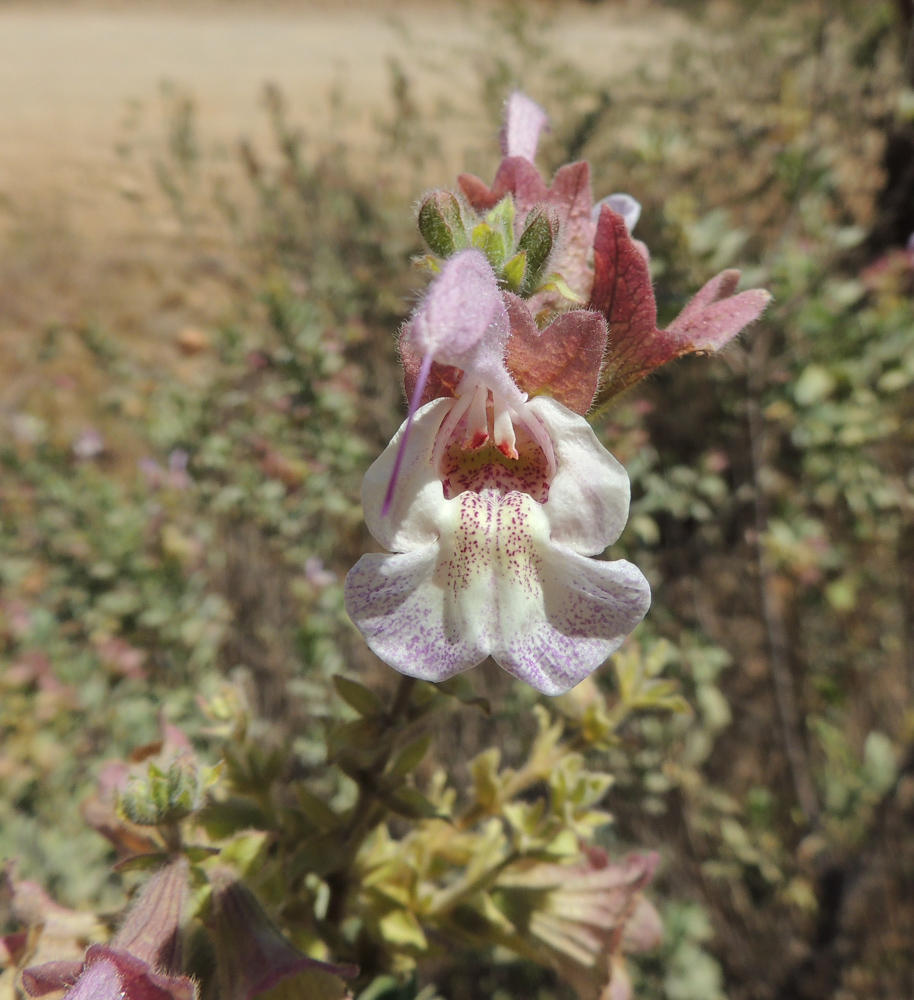
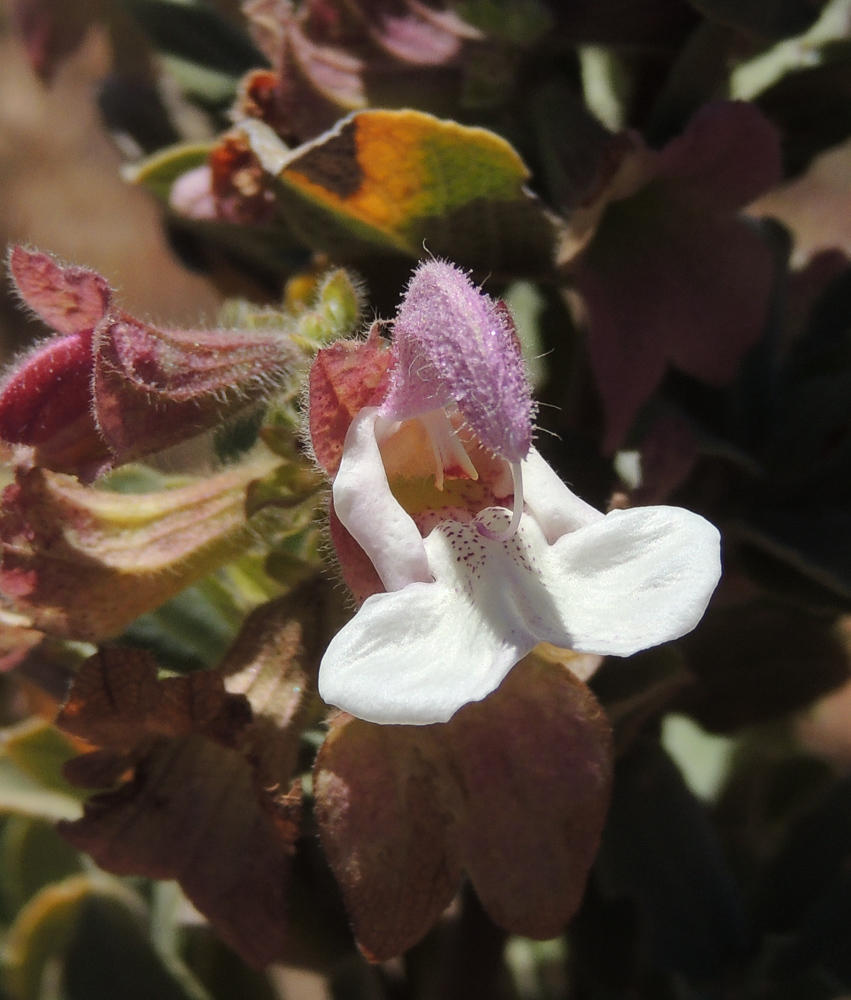
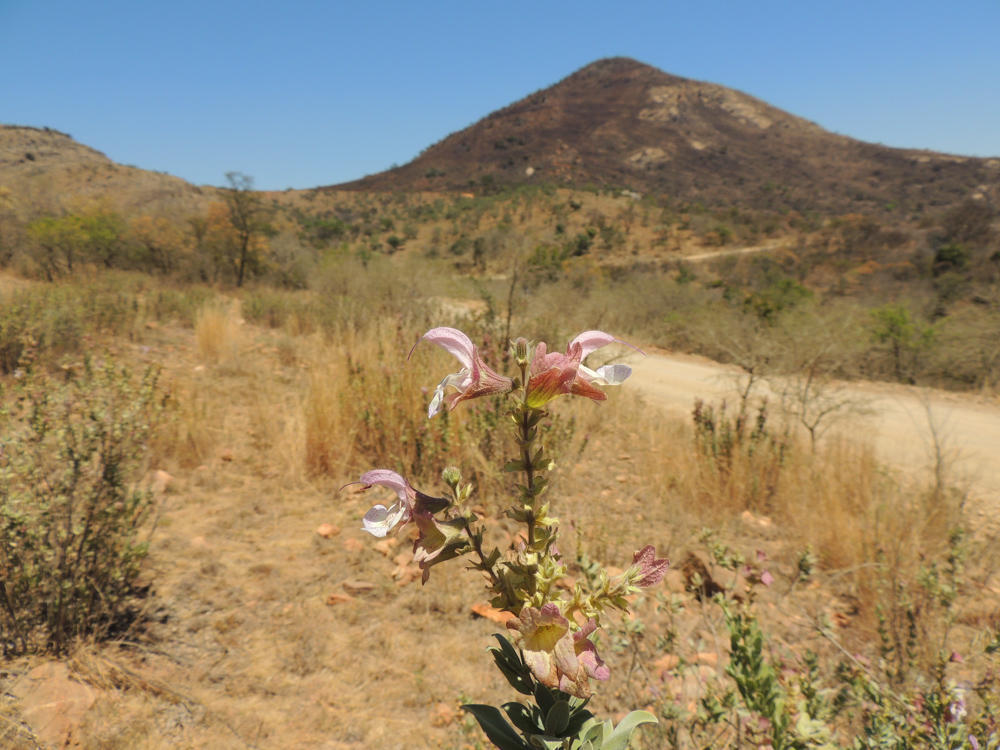
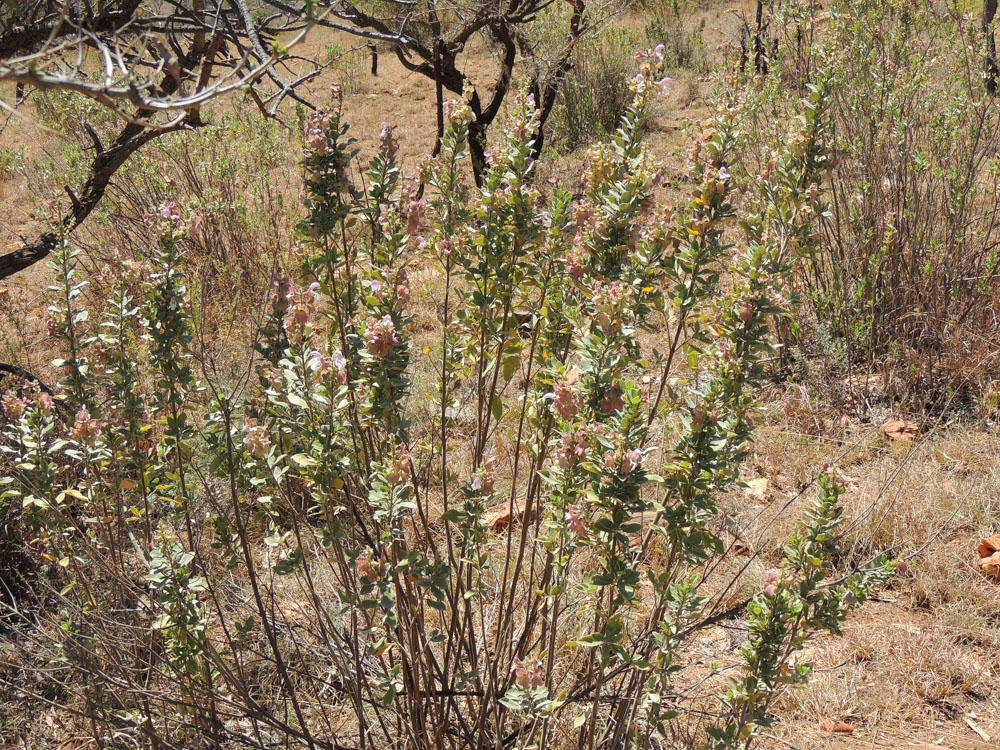
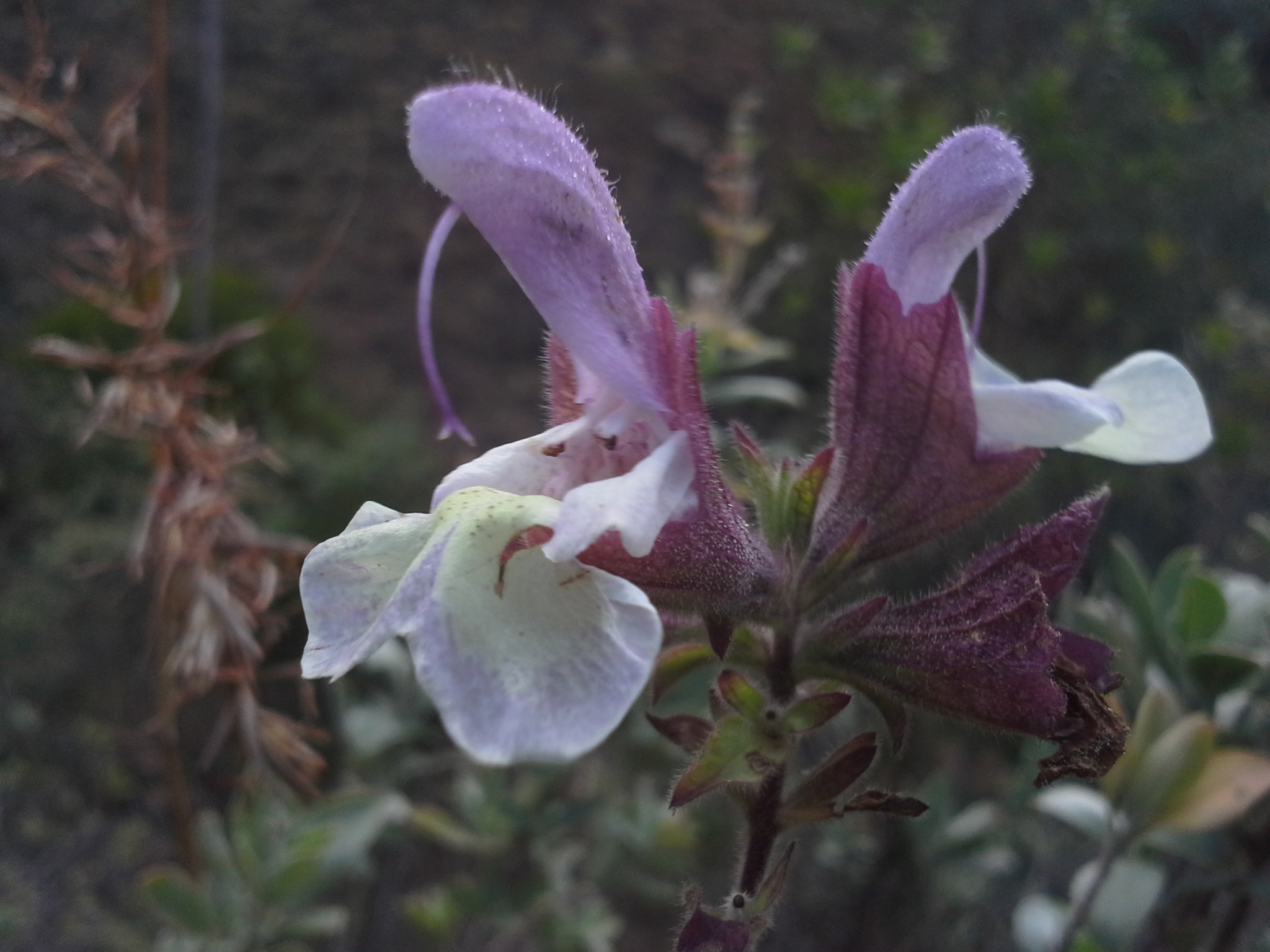
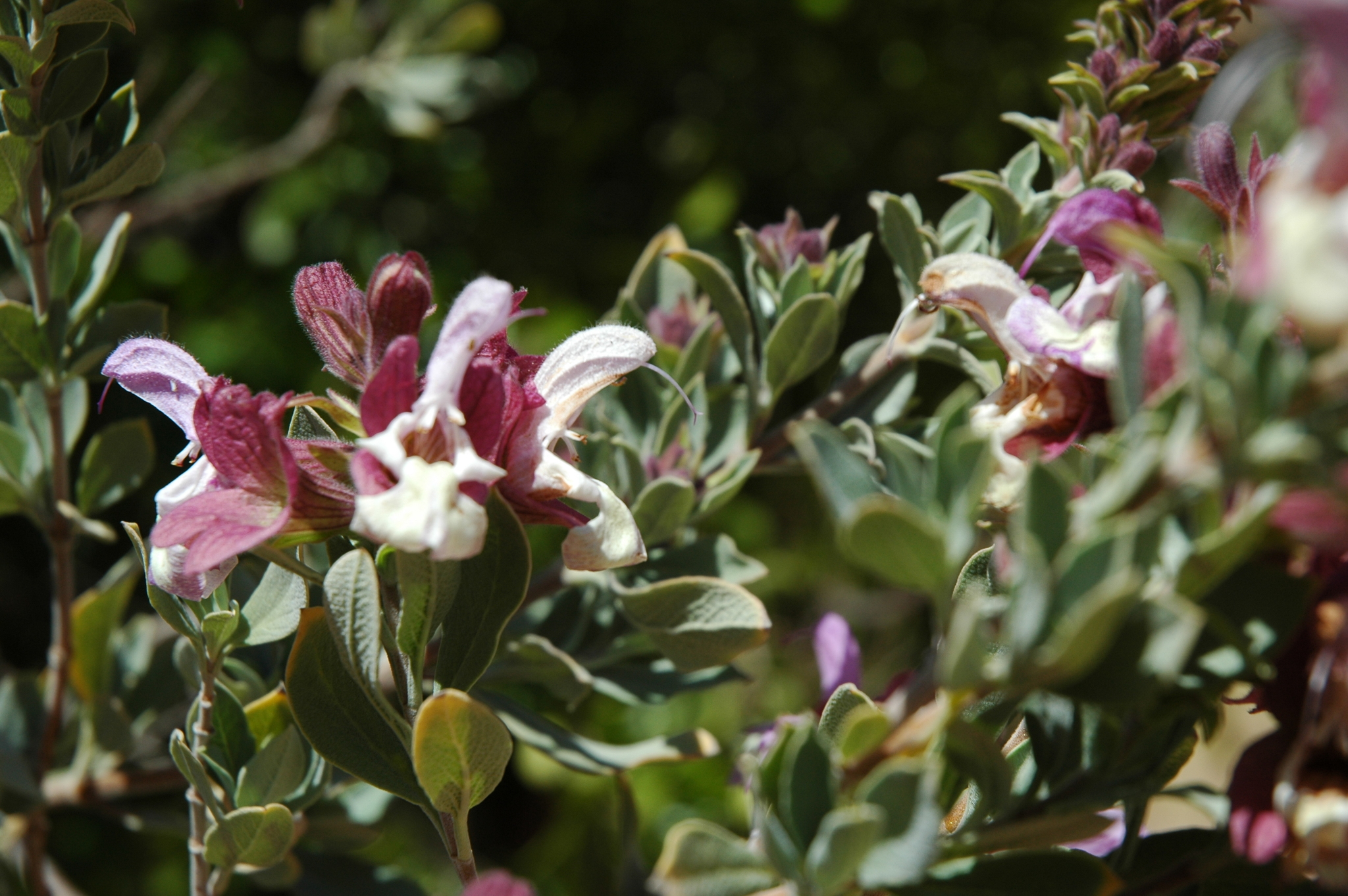
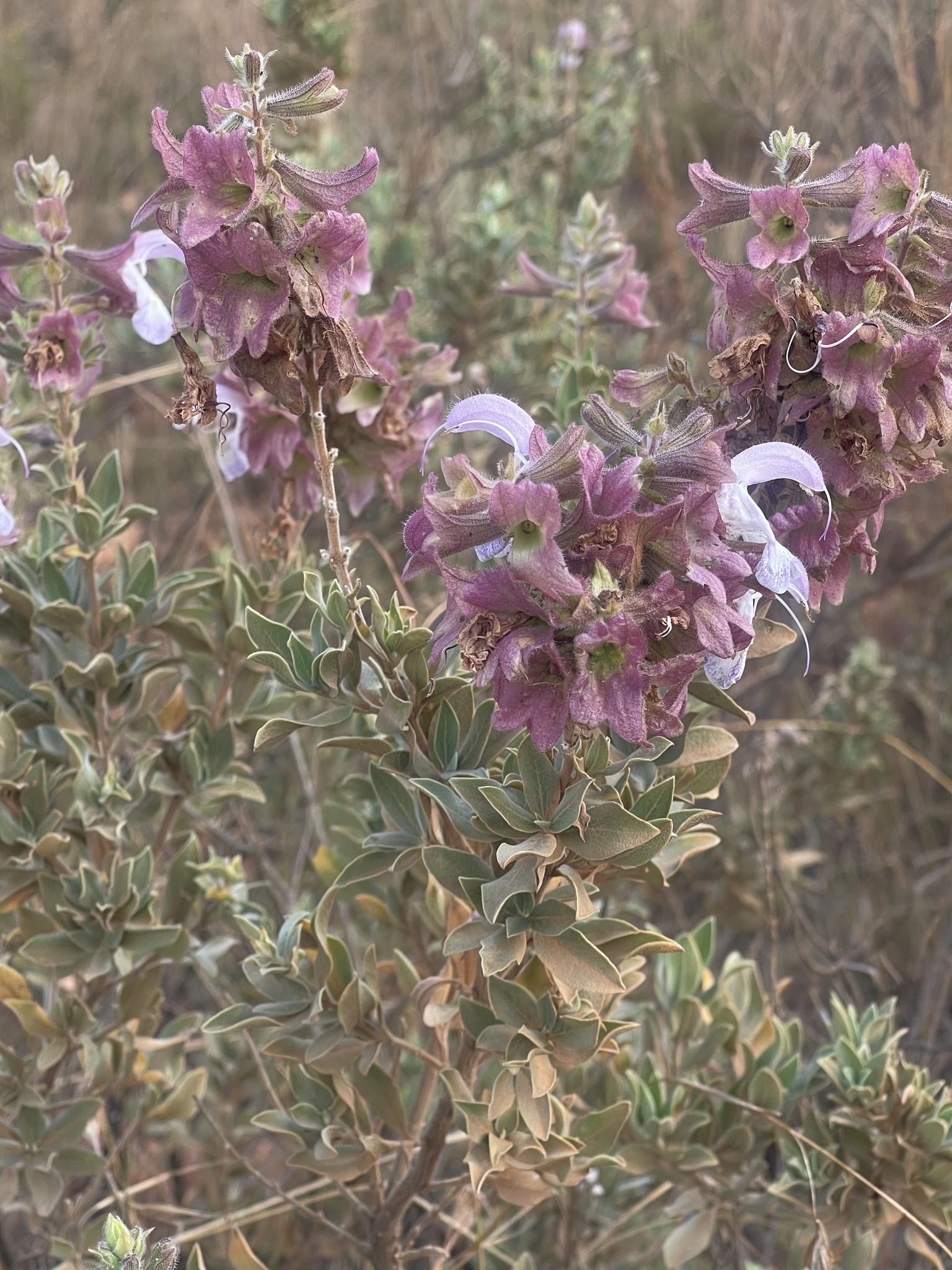
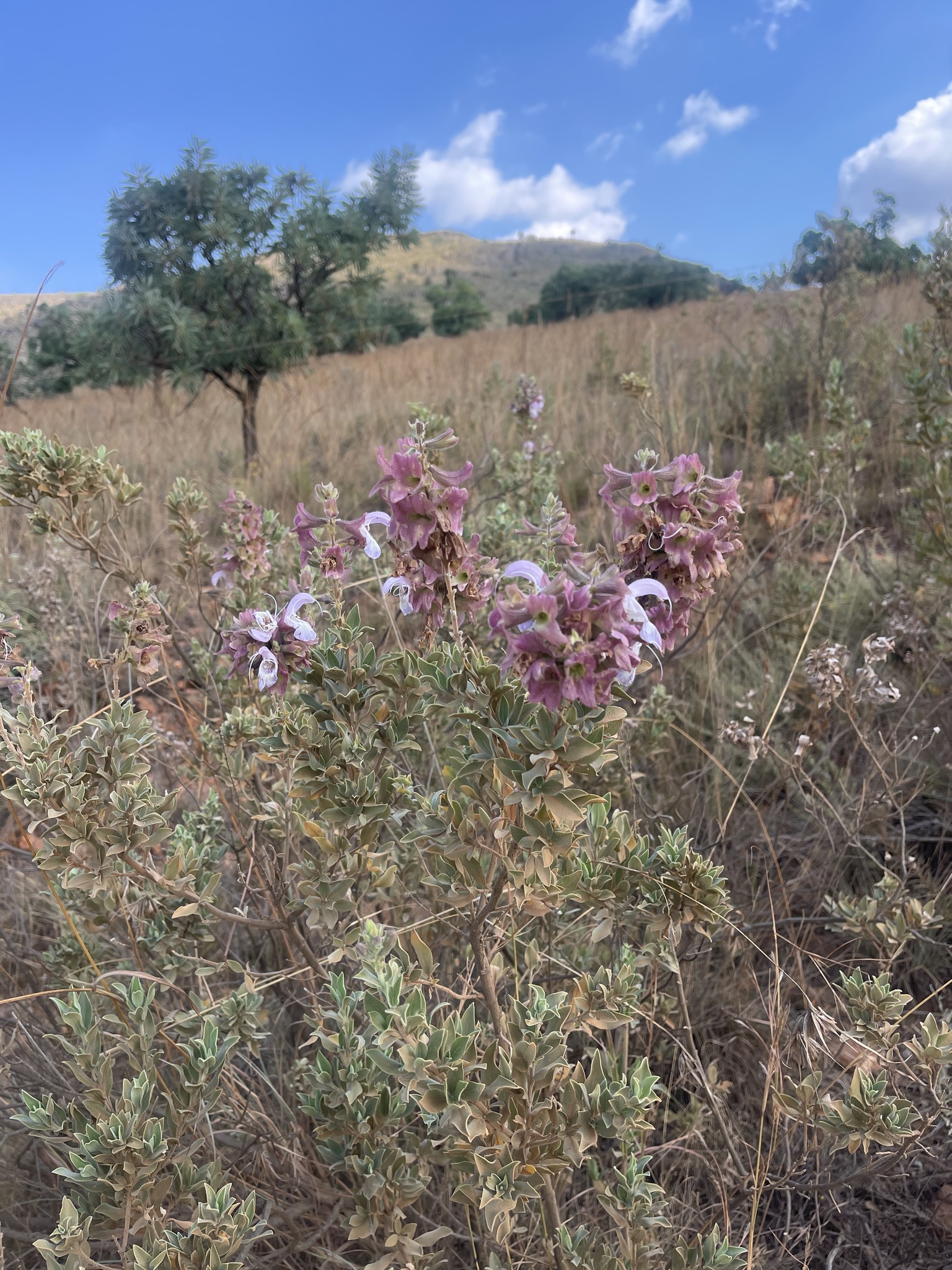
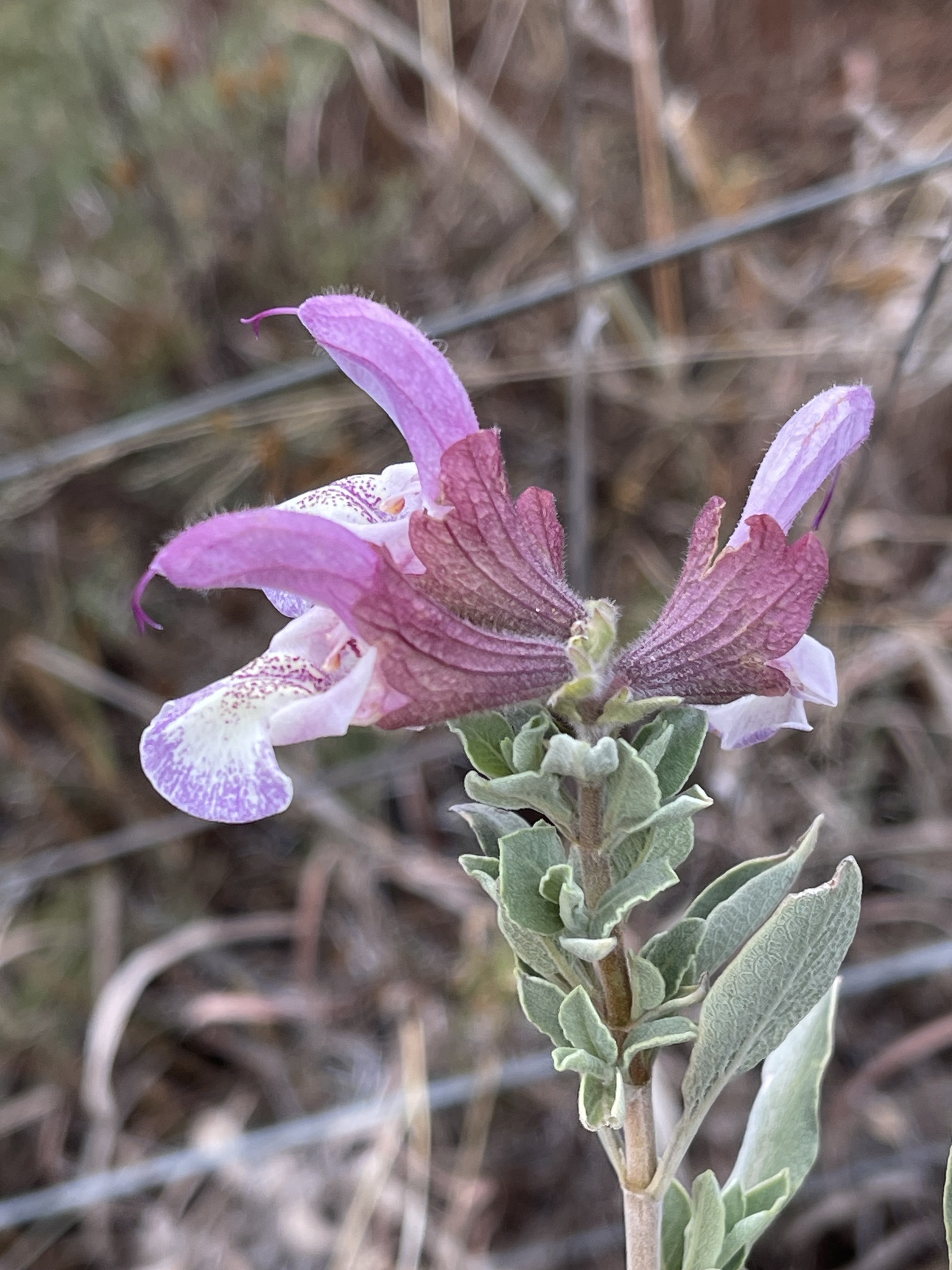
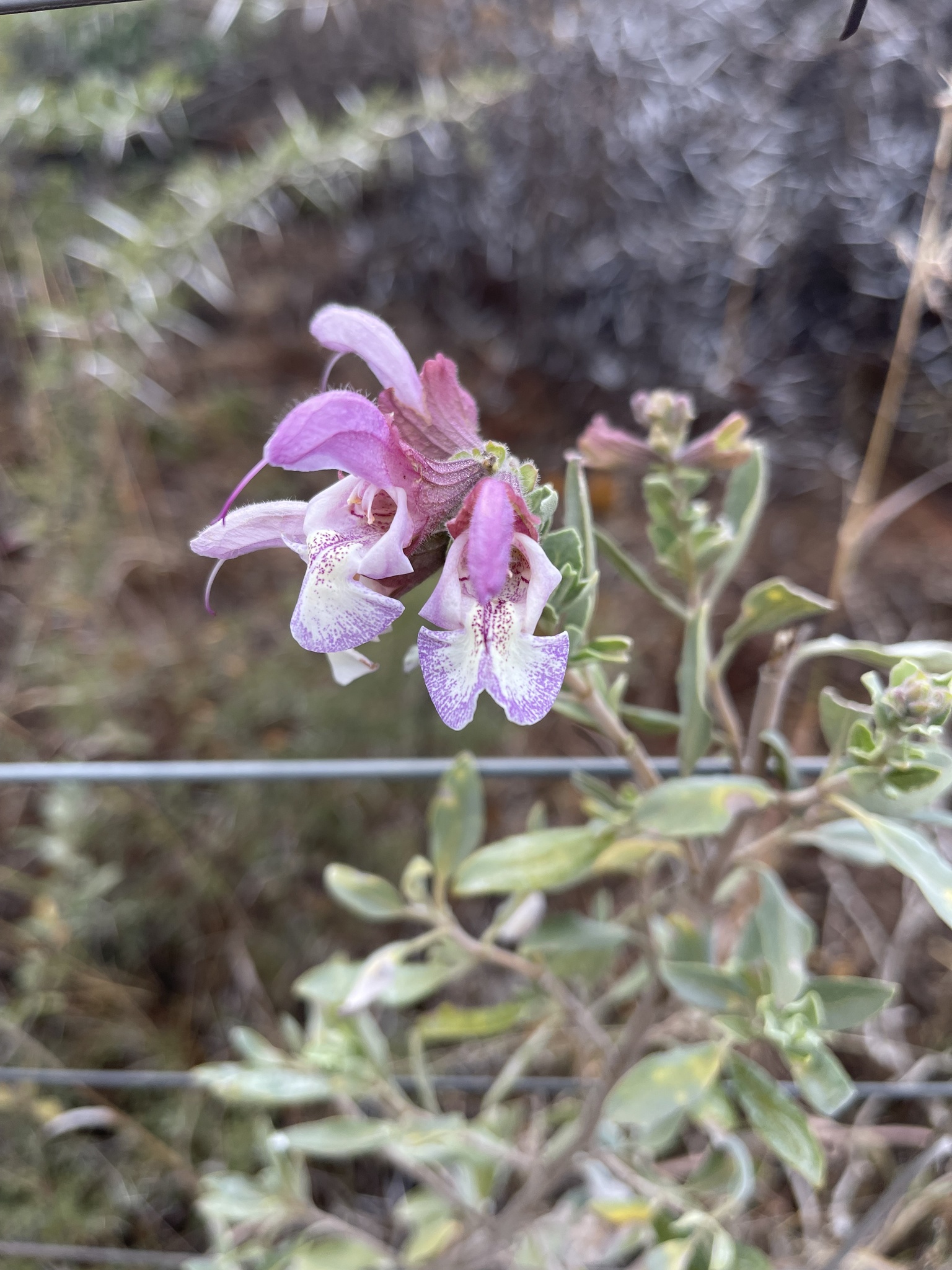
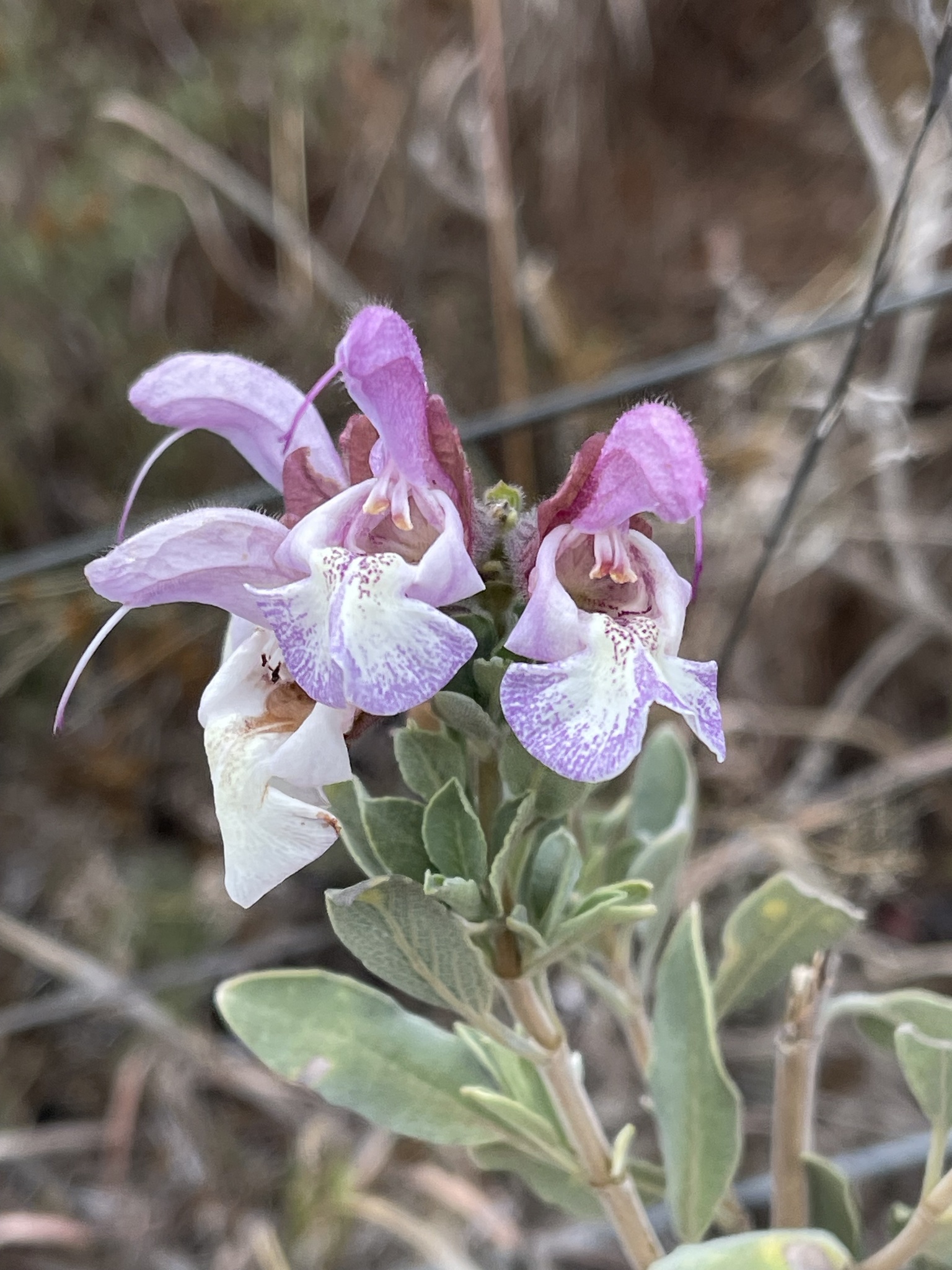
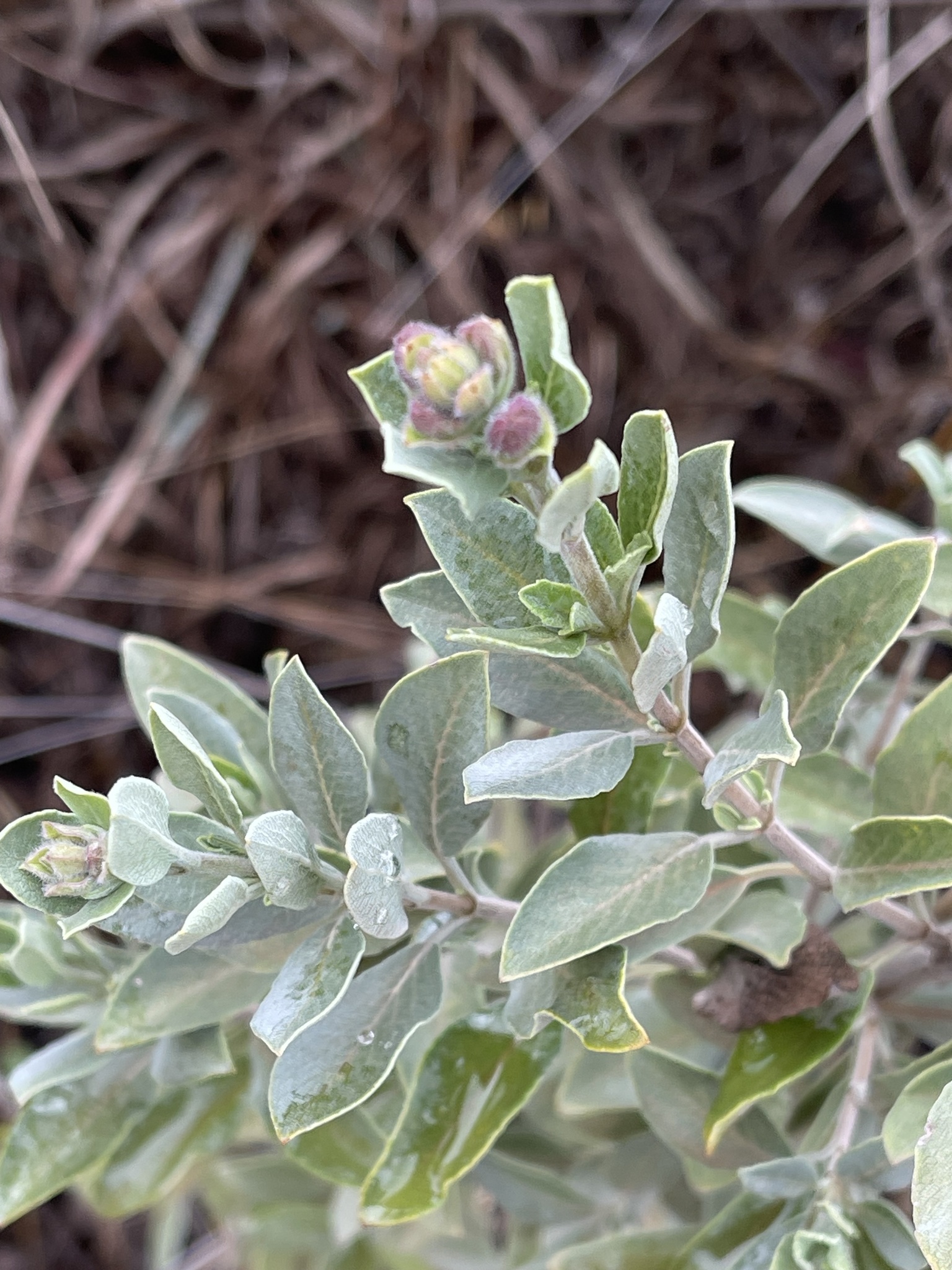
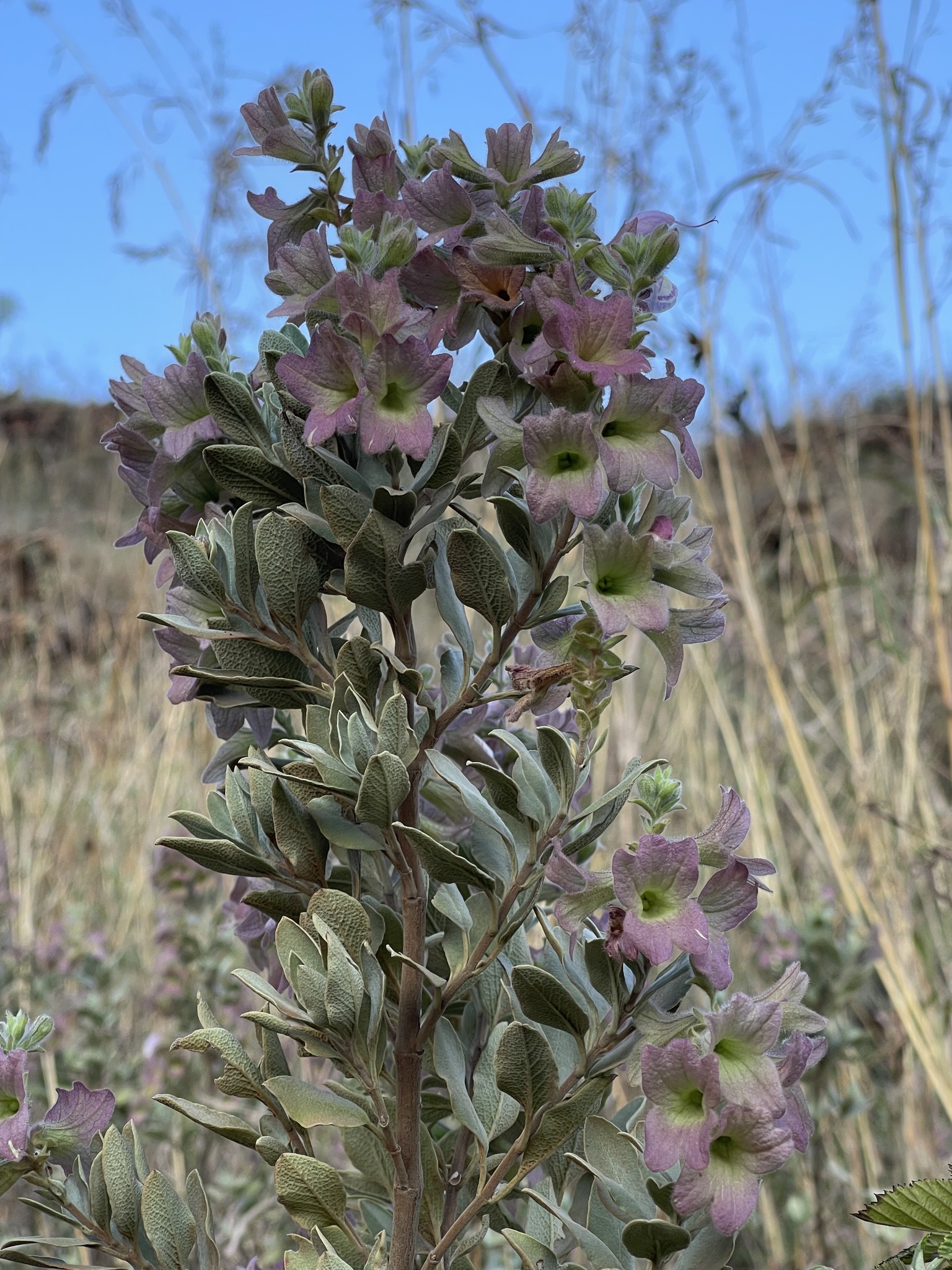
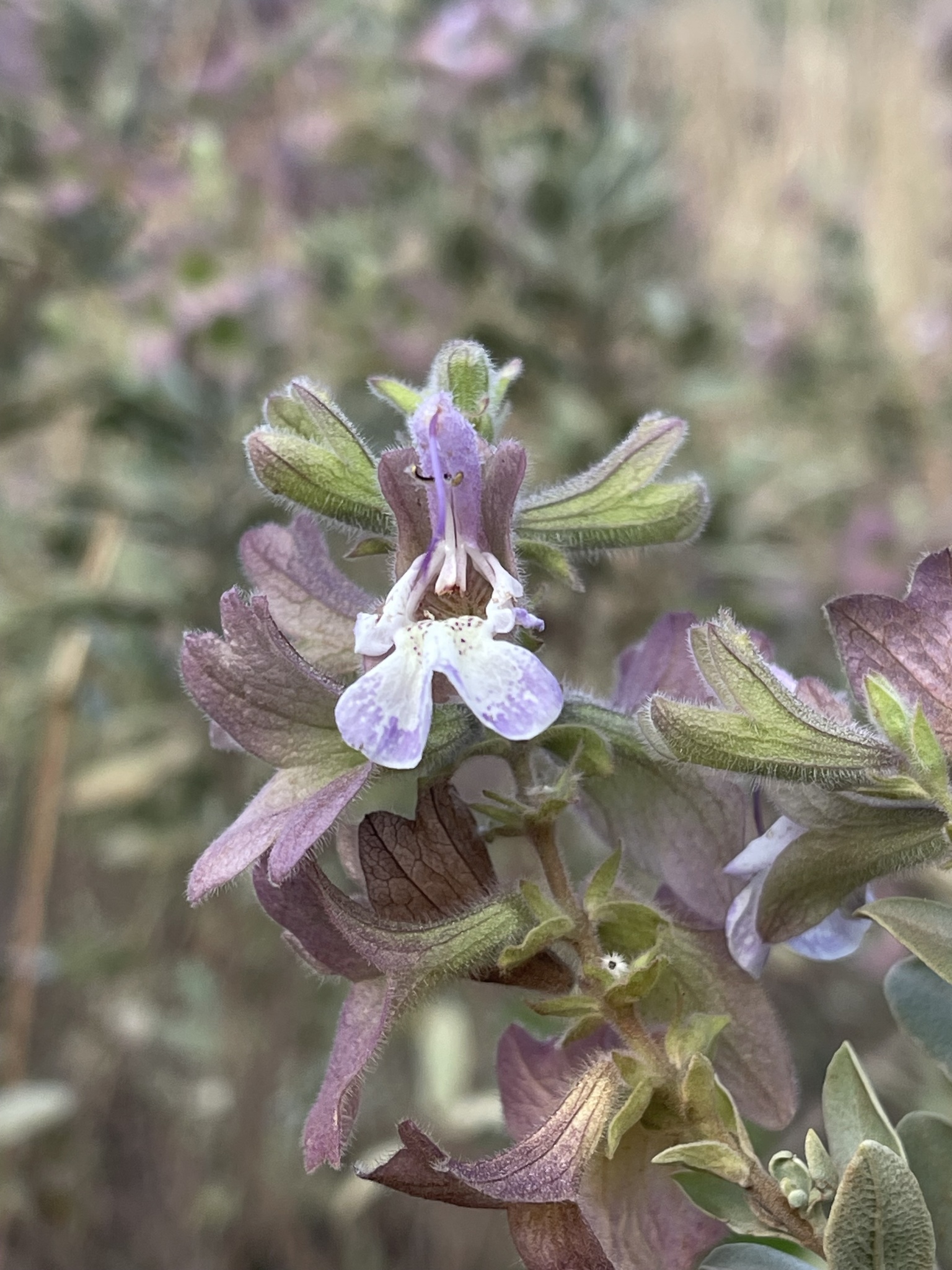
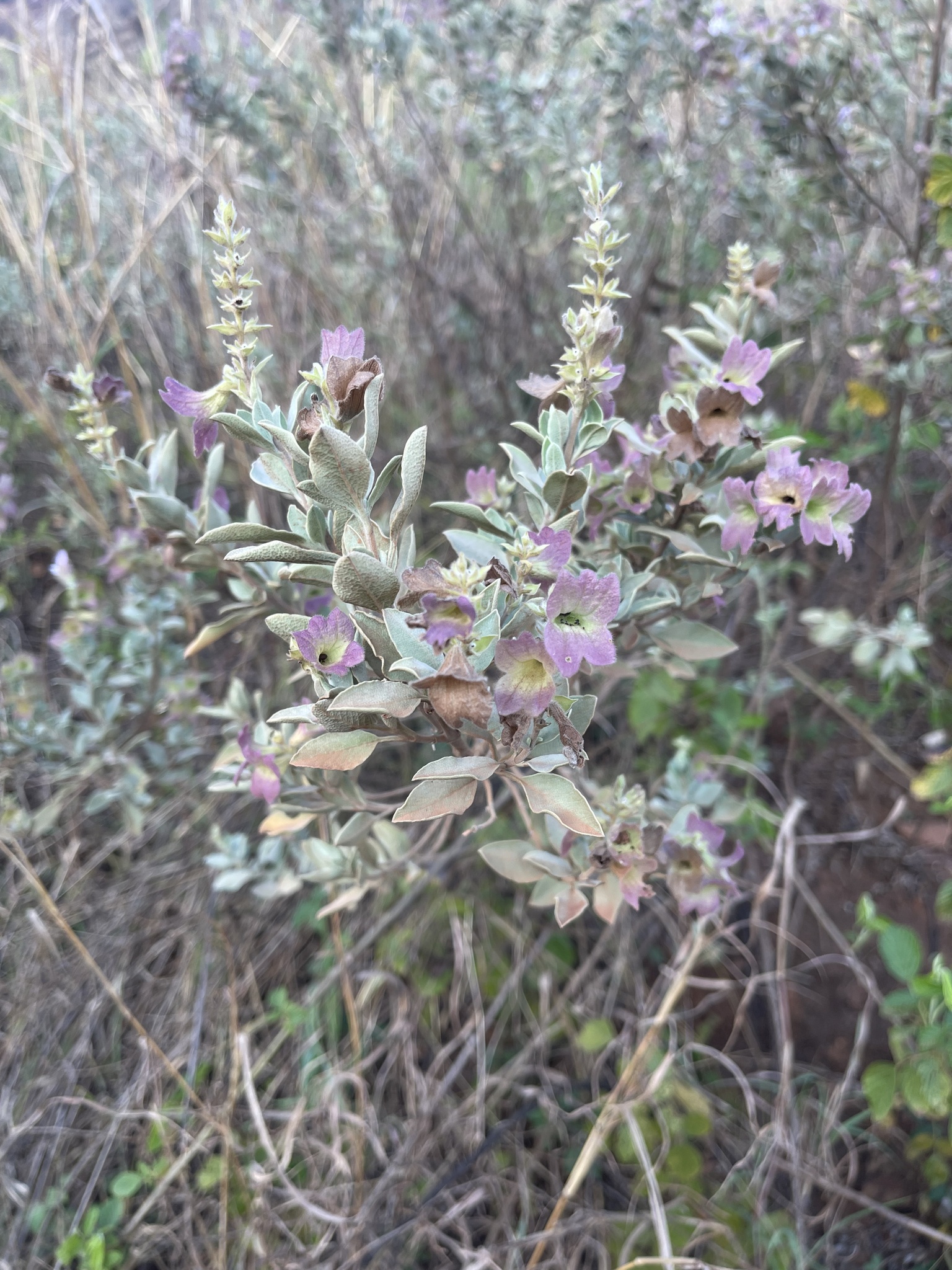
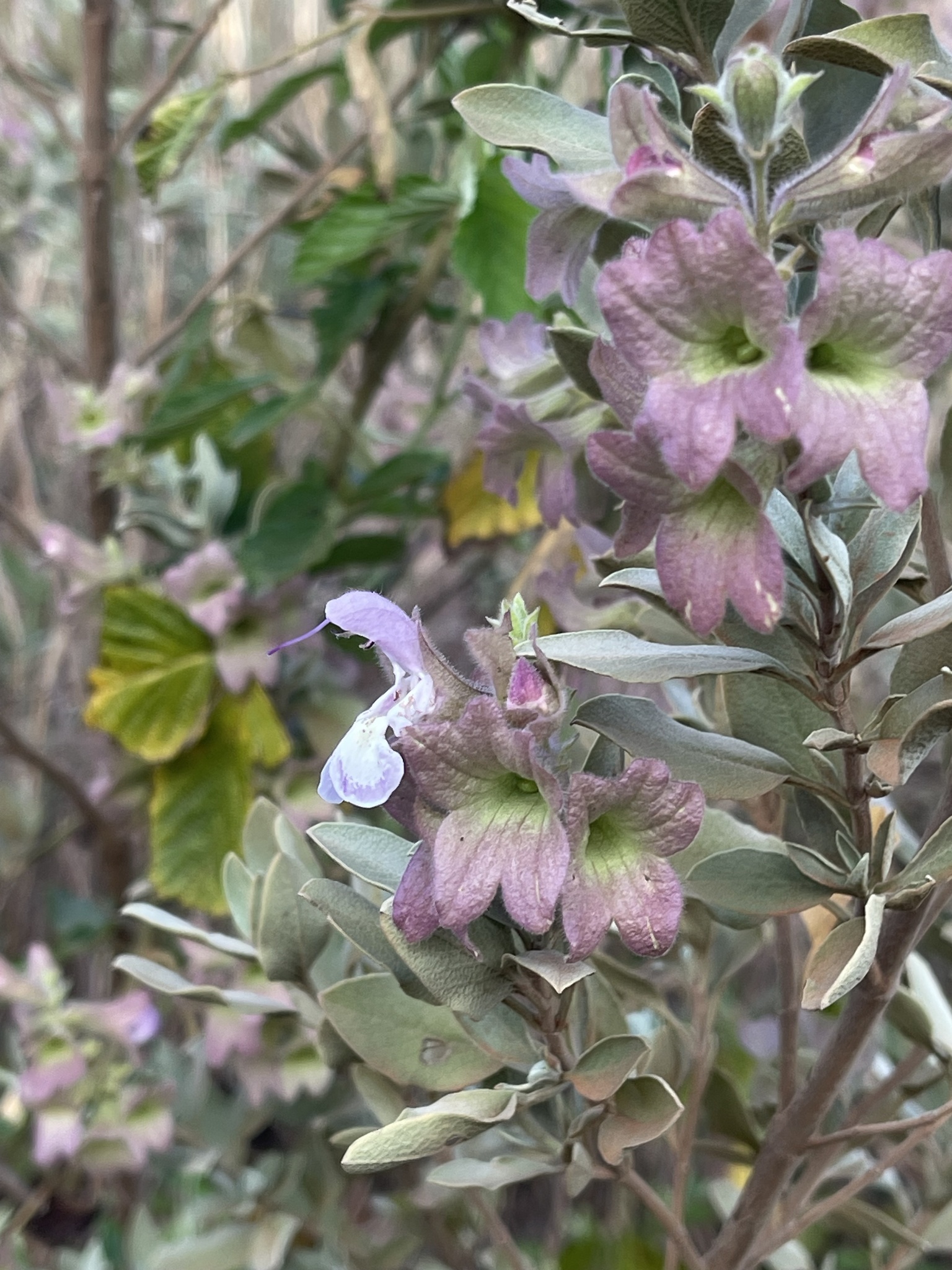
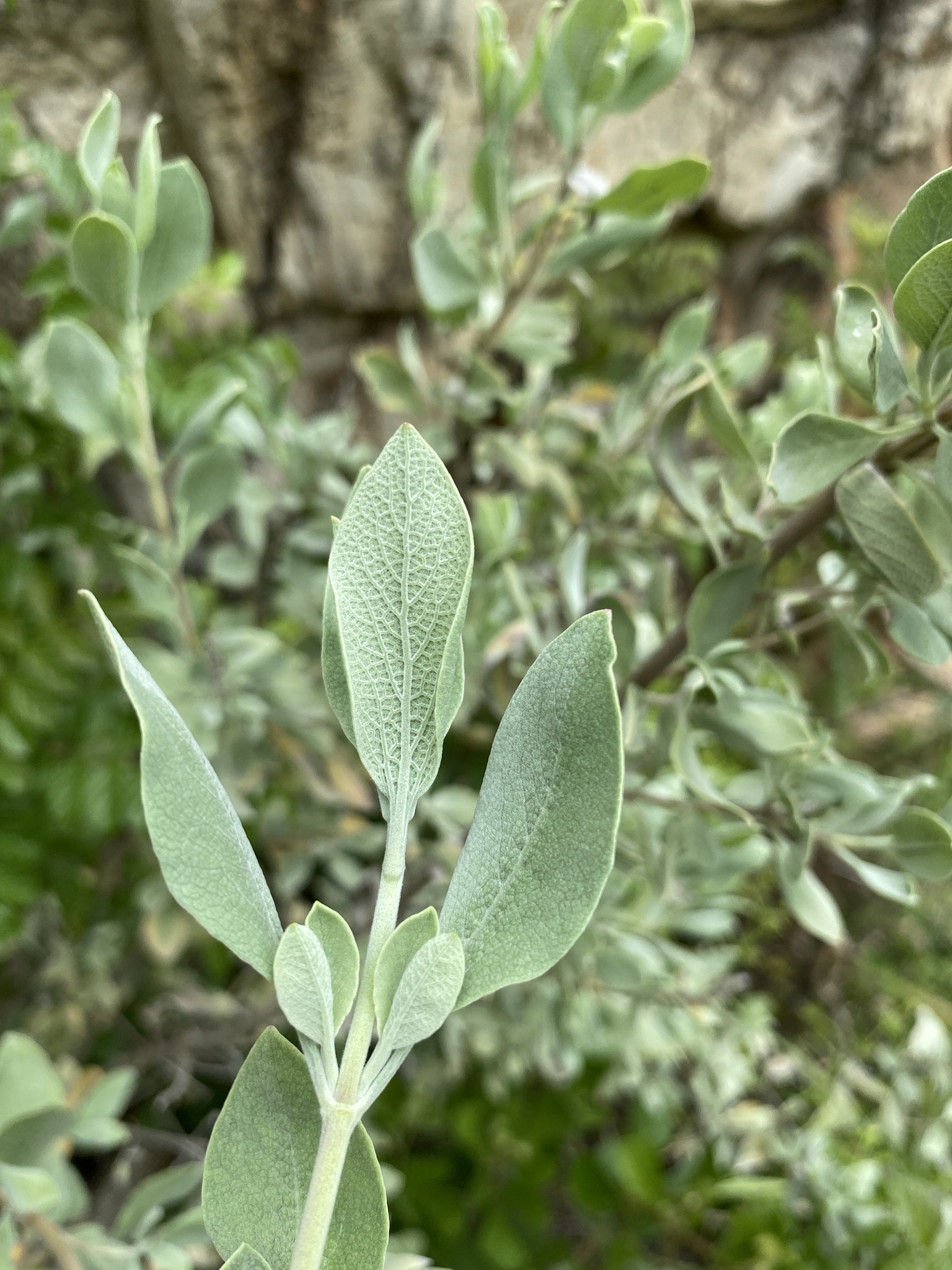
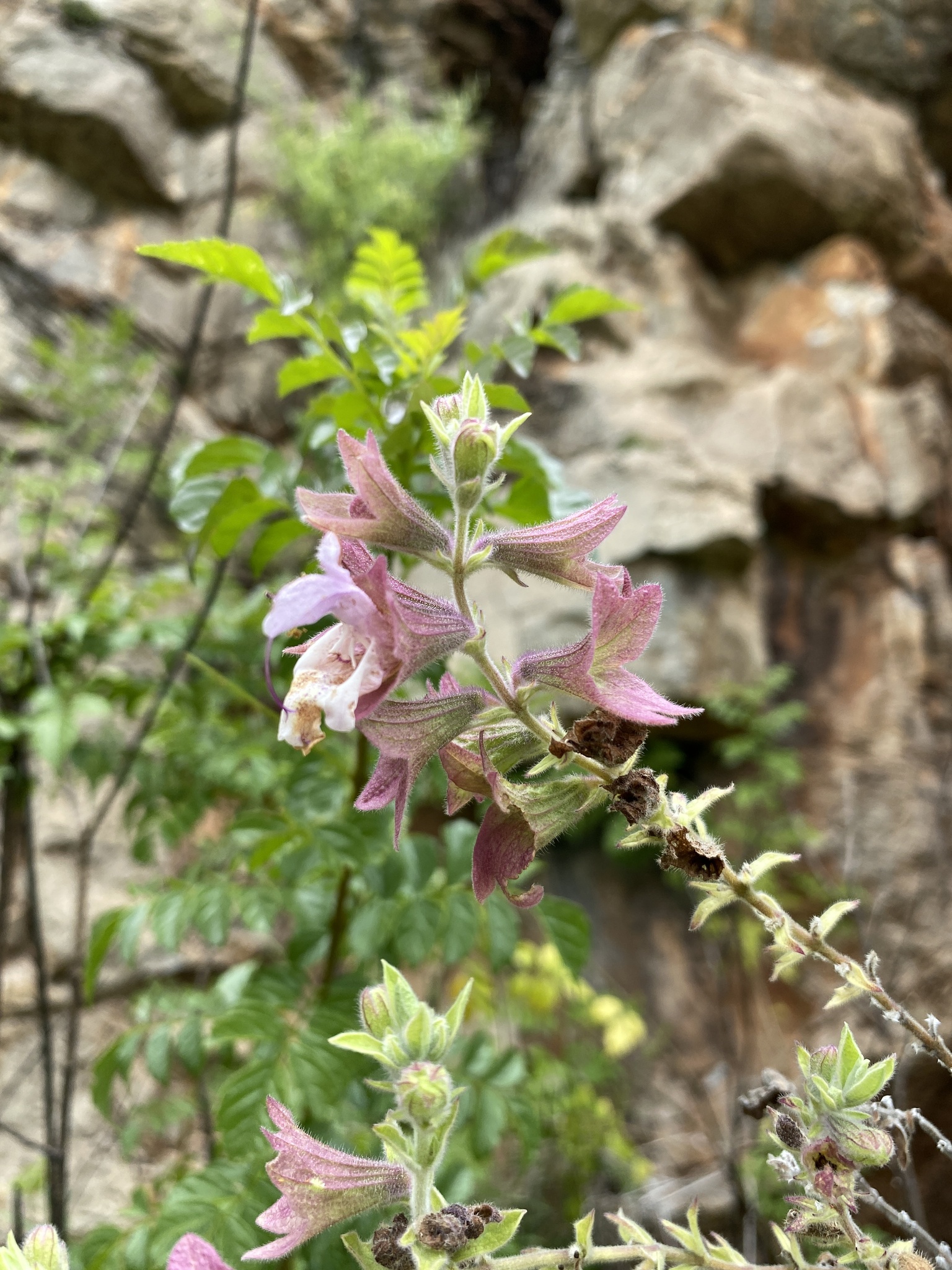
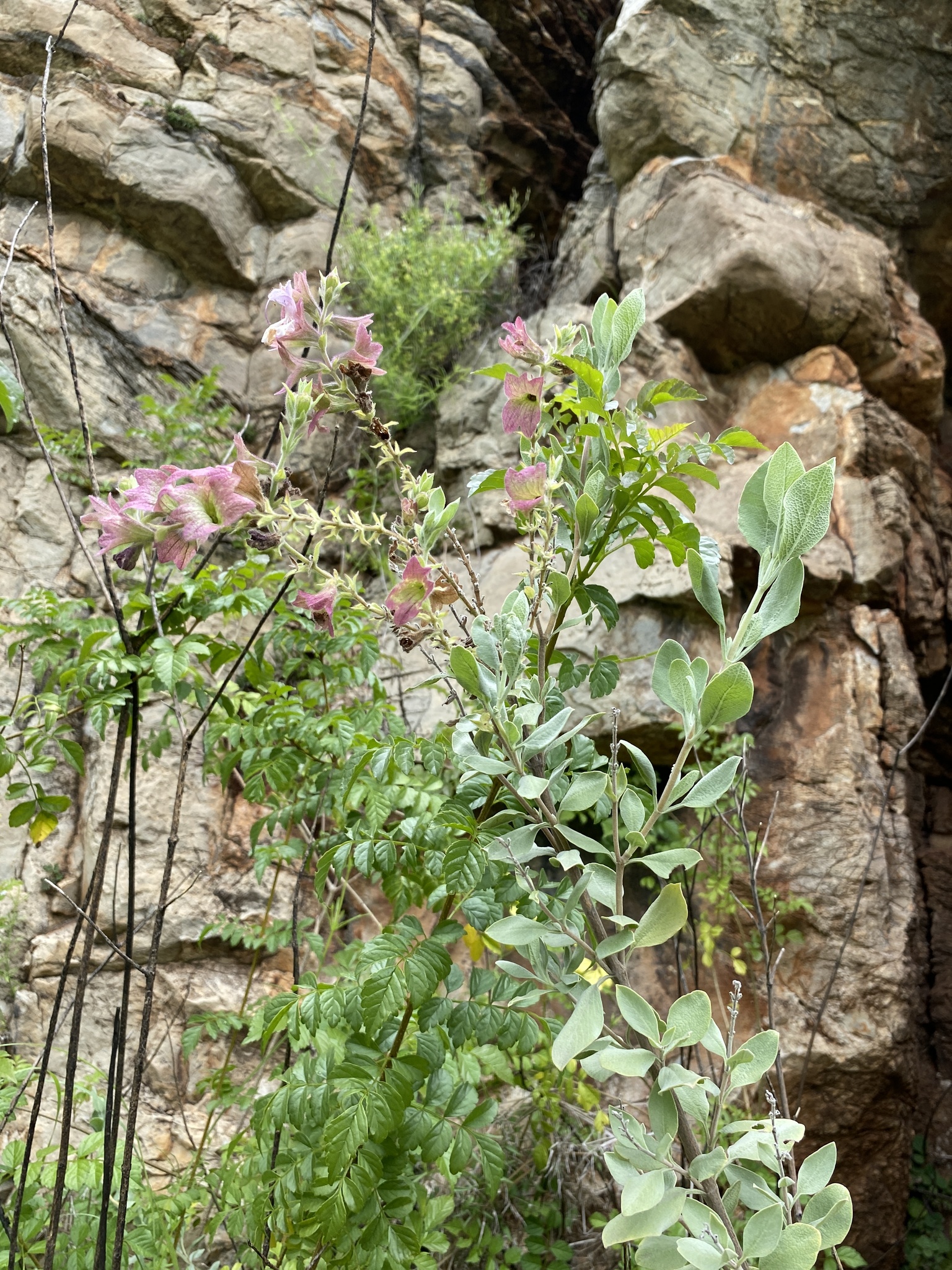
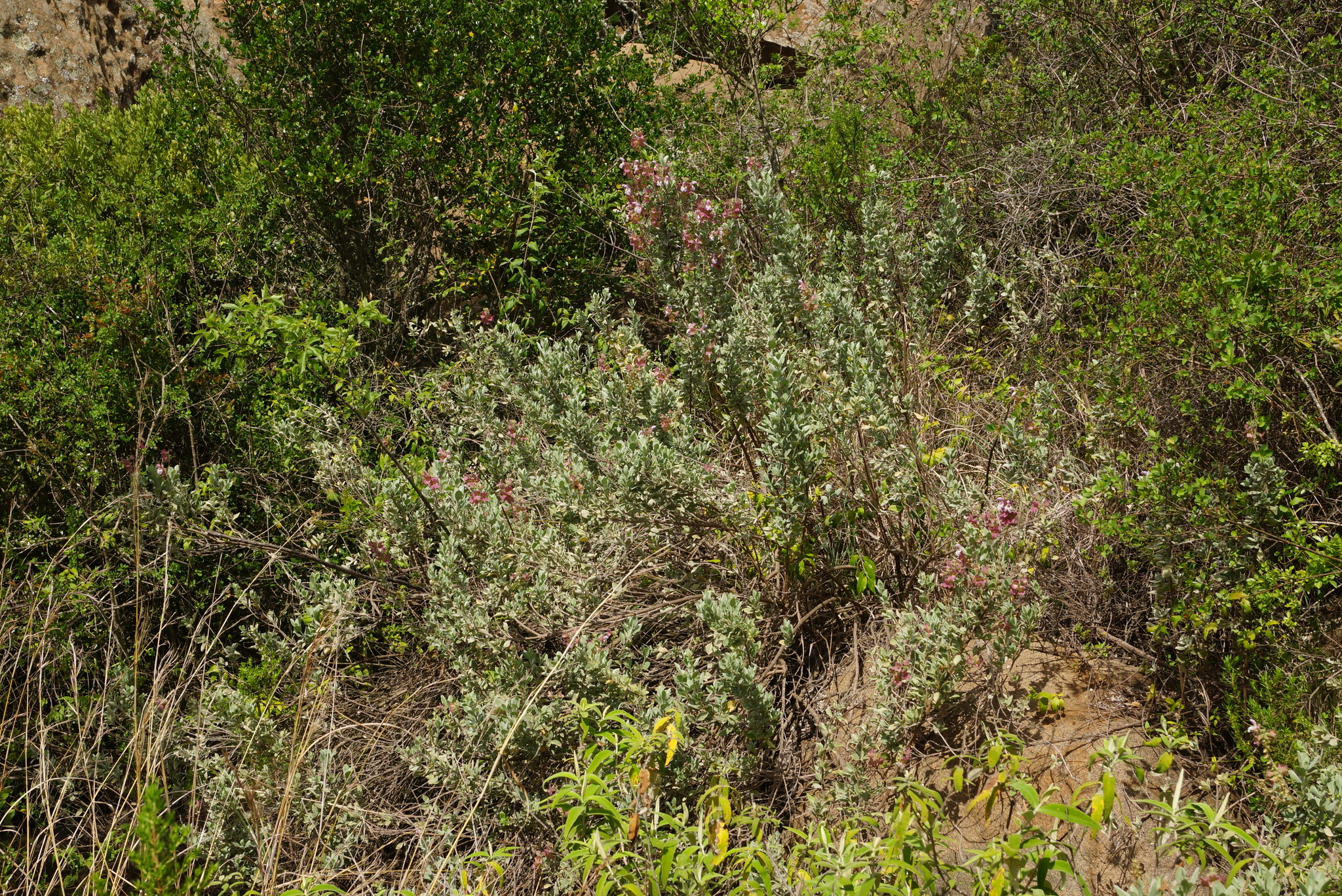
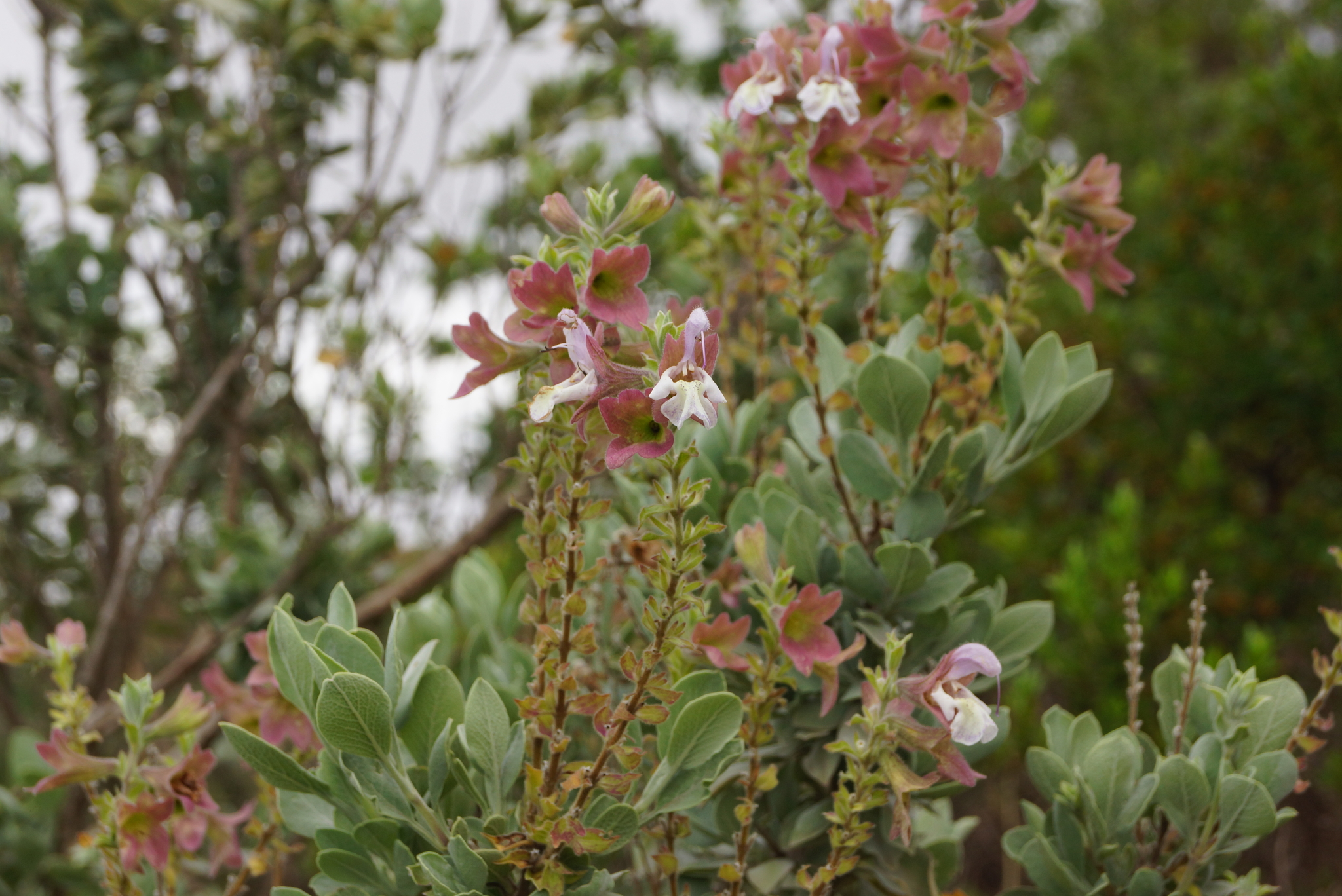
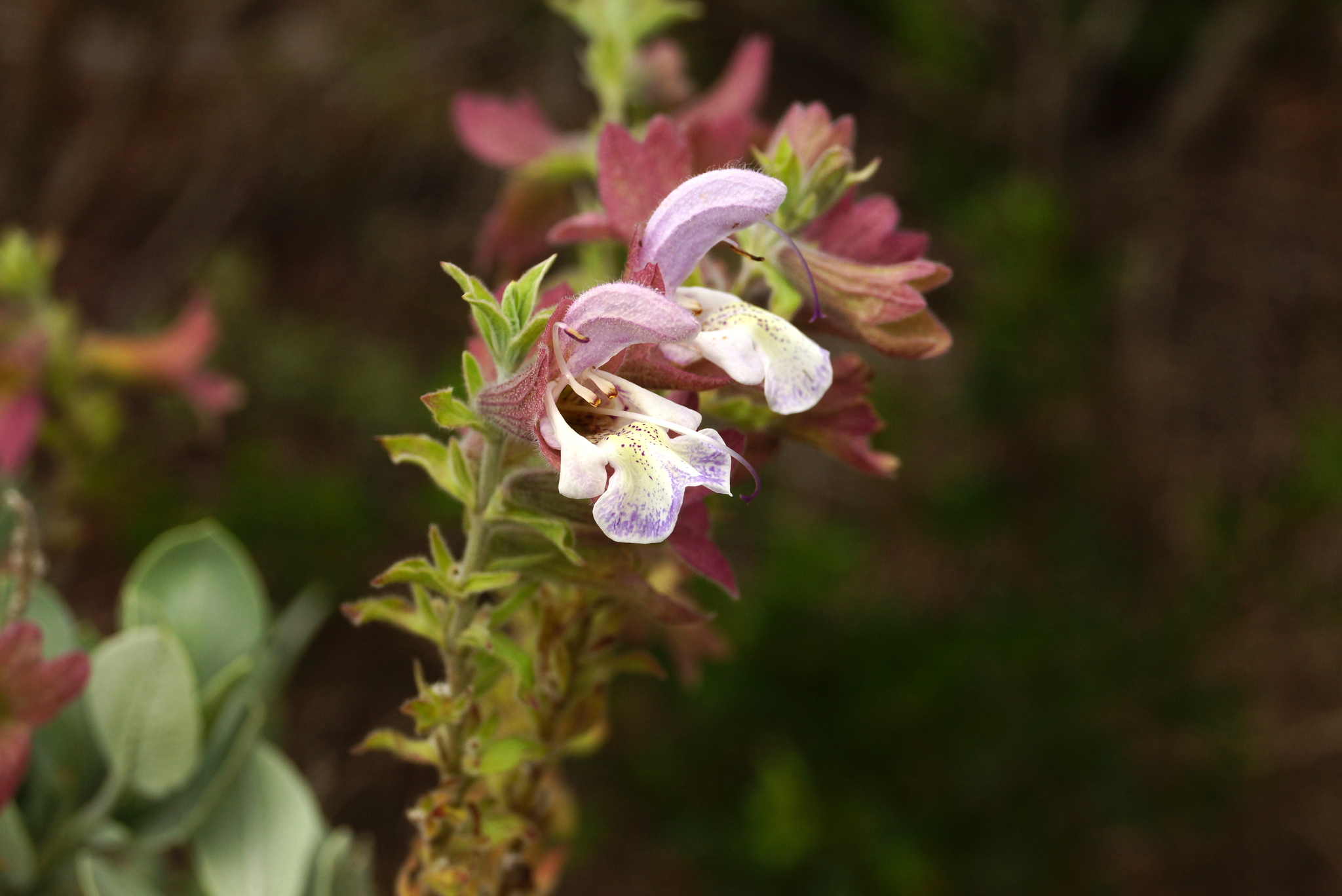
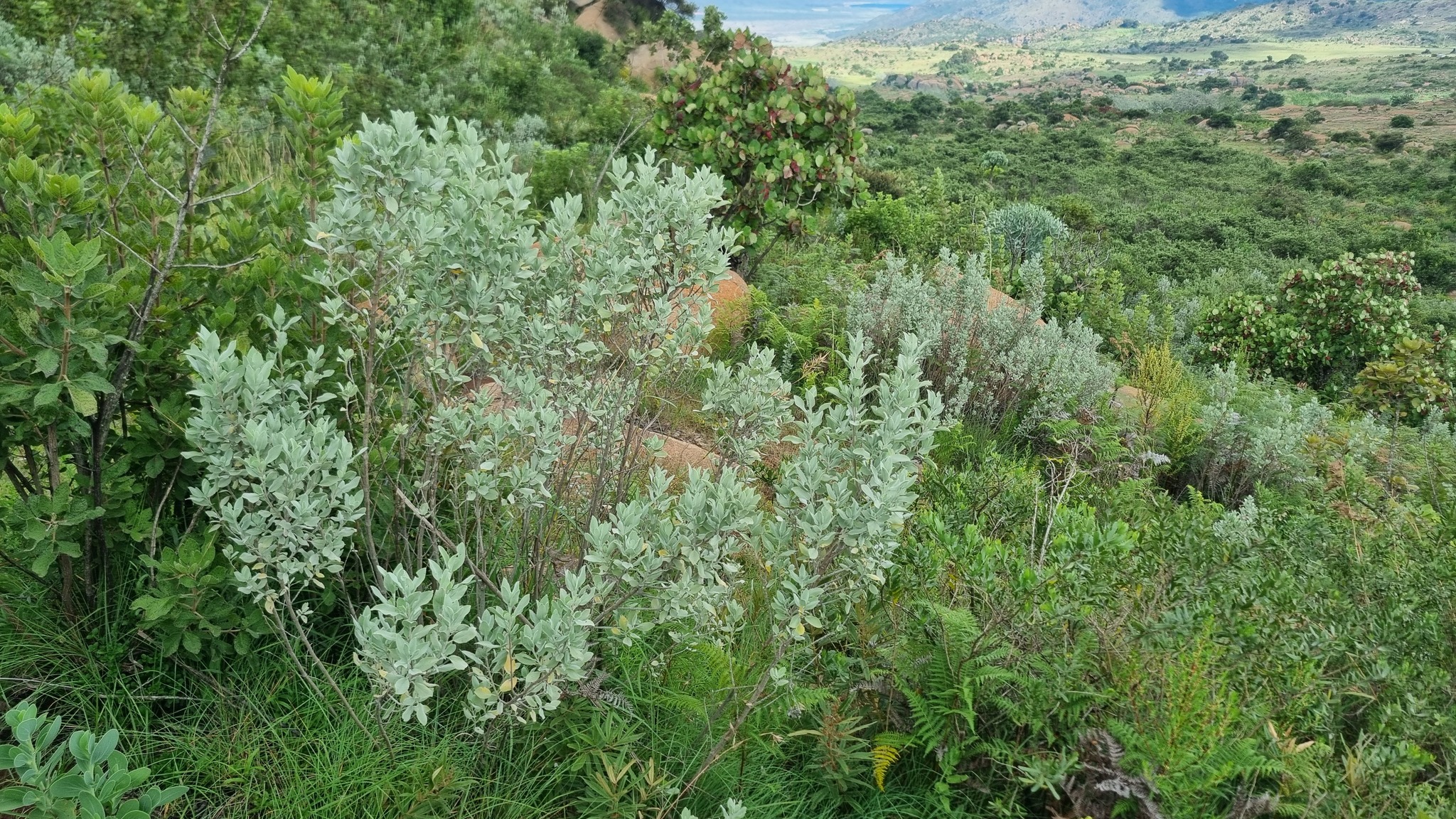
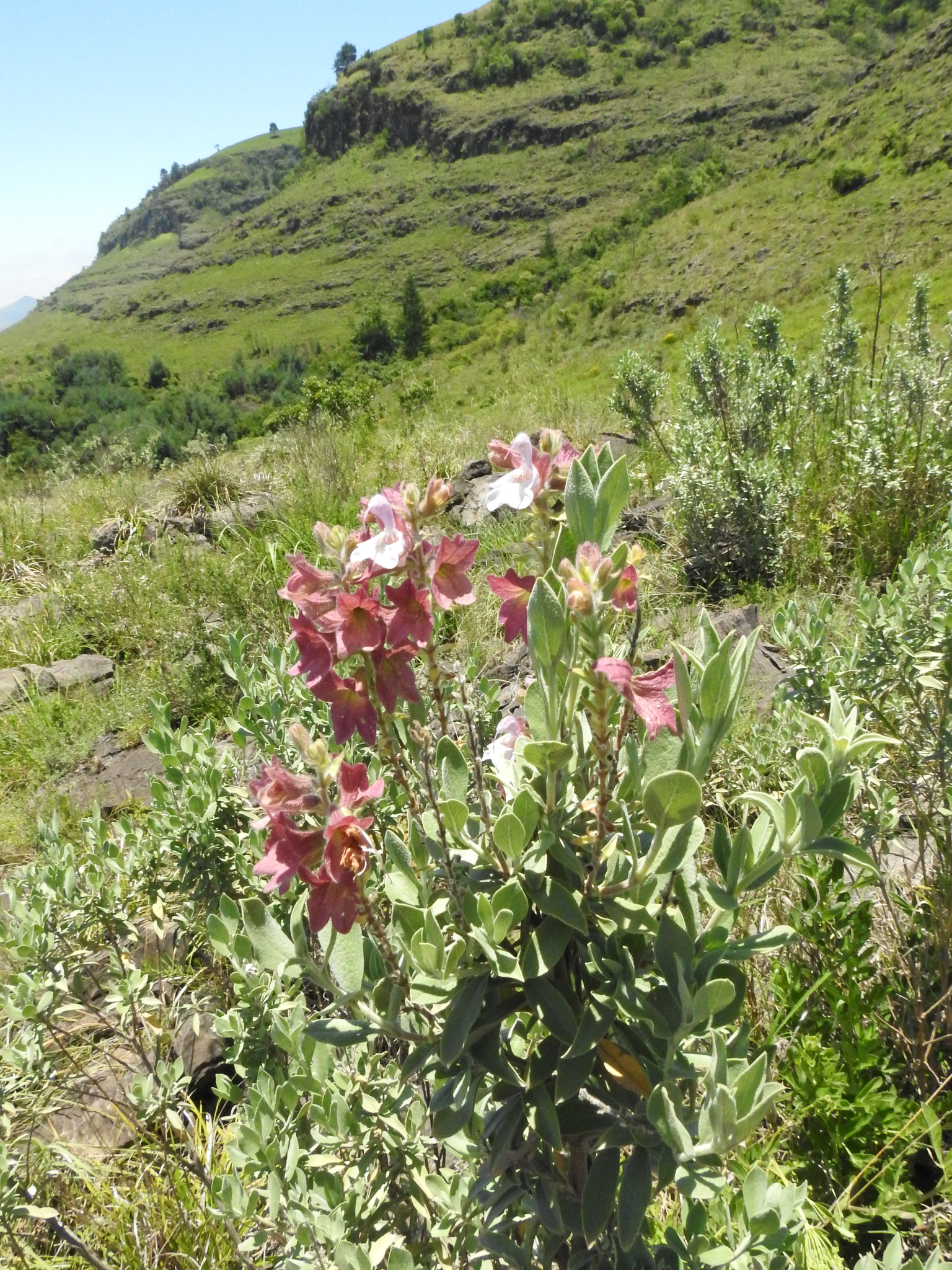
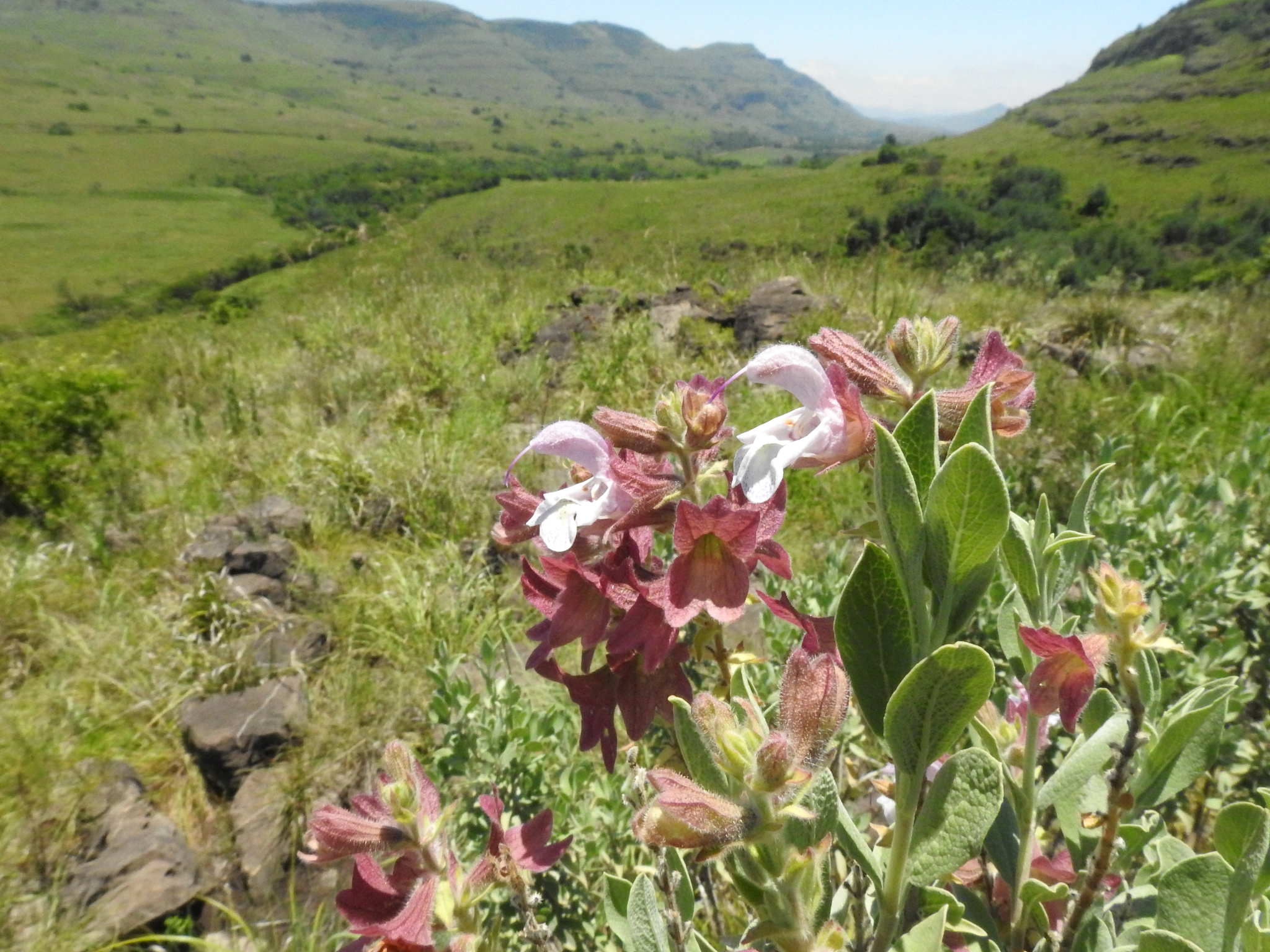
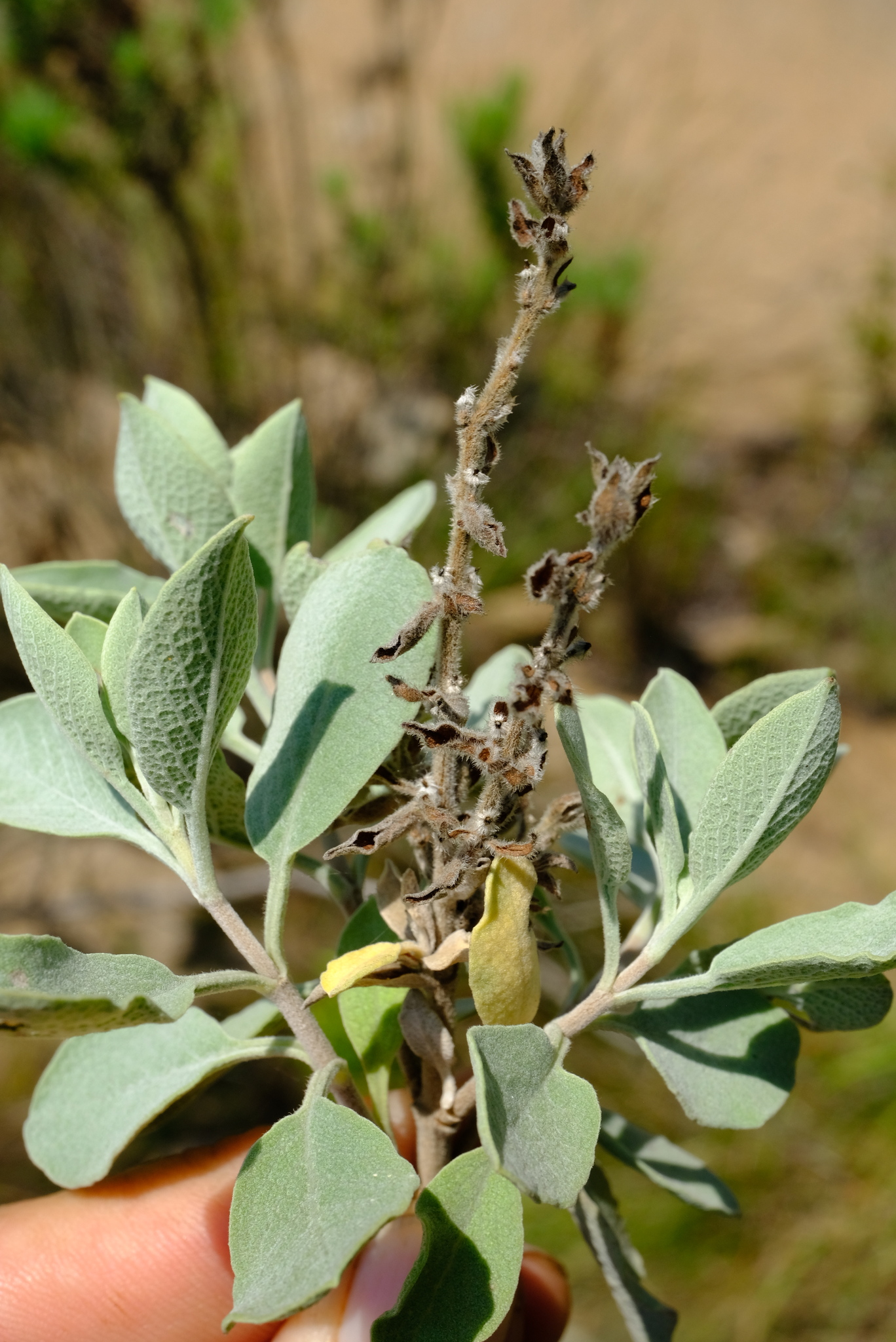
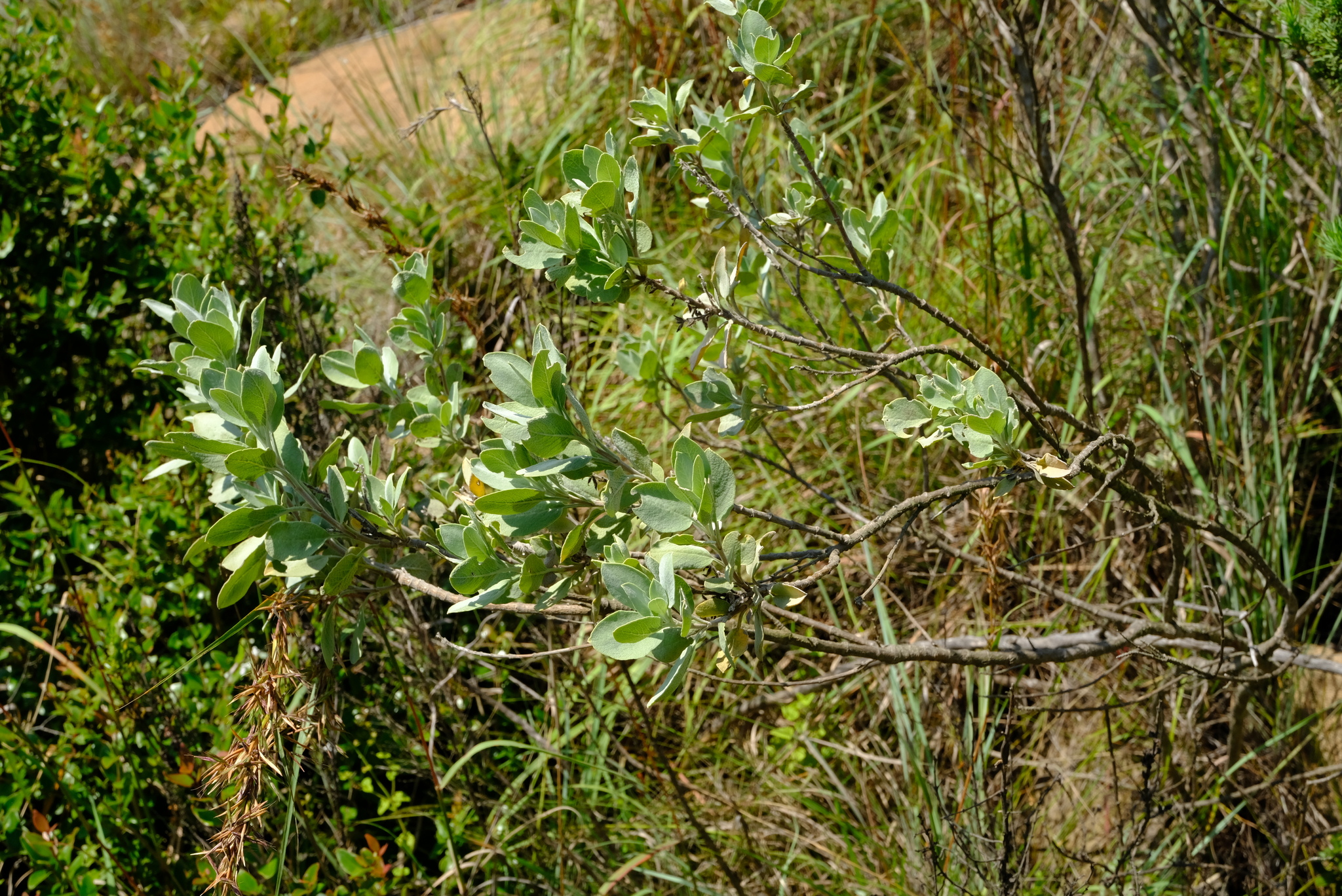
Shrub 1-2 m tall, branched from the base; stems terete, ascending, densely covered with a short whitish crisped tomentum. Leaves petiolate; blade simple, elliptic to obovate, 25-50(-65) x 12-20(-30) mm, densely greyish appressed tomentose on both surfaces, reticulate beneath and gland-dotted, apex obtuse, base obtuse to cuneate, margin entire. Inflorescence compact, of several 2-flowered verticils. Calyx broadly campanulate, often purple-tinged, glandular hirsute, enlarging to 25 mm long in fruit. Corolla light pink or lilac with cream or yellow markings on the lower lip, 20-28 mm long; tube c. 10 mm long; upper lip falcate, 10-14 mm long; lower lip 12-18 mm long. From: Codd, LEW. 1985. Lamiaceae: 14. Salvia. In: OA Leistner (ed.). Fl. S. Africa 28(4): 79-102. Botanical Research Institute, Department of Agriculture and Water Supply, Pretoria. [http://www.biodiversitylibrary.org/item/209555#page/9/mode/1up] [CC BY]
Usually on dolomitic outcrops. From: Codd, LEW. 1985. Lamiaceae: 14. Salvia. In: OA Leistner (ed.). Fl. S. Africa 28(4): 79-102. Botanical Research Institute, Department of Agriculture and Water Supply, Pretoria. [http://www.biodiversitylibrary.org/item/209555#page/9/mode/1up] [CC BY]
Restricted to the eastern and north-eastern Transvaal. From: Codd, LEW. 1985. Lamiaceae: 14. Salvia. In: OA Leistner (ed.). Fl. S. Africa 28(4): 79-102. Botanical Research Institute, Department of Agriculture and Water Supply, Pretoria. [http://www.biodiversitylibrary.org/item/209555#page/9/mode/1up] [CC BY]
1000 to 1900 m
This map contains point-based occurrences at different locations
Occurrence in the Flora of Southern Africa (FSA) countries and South African provinces. Residence status indicates if a taxon is indigenous, endemic, naturalised or invasive in a specific region. This data is based on specimen records and literature
FSA
SA
BOT
NAM
ESW
LES
WC
EC
NC
FS
GA
KZN
LP
MP
NW
Absent
Indigenous
Endemic
Naturalised
Invasive
Names and Sources
Classification
KINGDOM Plantae
SUBKINGDOM Phanerogamae
PHYLUM Anthophyta
ORDER Lamiales
FAMILY Lamiaceae
SUBFAMILY Nepentoideae
TRIBE Mentheae
GENUS Salvia
SPECIES dolomitica
40 results for Salvia dolomitica Codd
Year
Barcode: PRE0114587-0 Collector(s) & number: Codd, LEW, 3089 | 1947-10-14
South Africa, Limpopo, LETABA DIST; THE DOWNS; 2 MI. S. OF POST OFFICE
Data Resource: BODATSA View record
Barcode: PRE0114601-0 Collector(s) & number: Codd, LEW, 10400 | 1963-12-19
South Africa, Limpopo, PIETERSBURG DIST.; WOLKBERG; 12 MI. SE. OF BOYNE ON RD. TO ASHMOLE DALES
Data Resource: BODATSA View record
Barcode: PRE0567871-0 Collector(s) & number: Lotter, MC, 404 | 1998-9-18
South Africa, Mpumalanga, Pilgrims Rest turnoff along Ohrigstad to Lydenburg Road.
Data Resource: BODATSA View record
Barcode: PRE0114598-0 Collector(s) & number: Maguire, B, 917 | 1951-7-22
South Africa, Limpopo, POTGIETERSRUST DIST.; MAKAPAN VALLEY
Data Resource: BODATSA View record
Barcode: PRE0897382-0 Collector(s) & number: Du Toit, GJ, 2084 | 1991-8-20
South Africa, Limpopo,
Data Resource: BODATSA View record
Barcode: PRE0739937-0 Collector(s) & number: Brusse, FA, 5610 | 1989-7-9
South Africa, Limpopo, ZEBEDIELA; BEWAARKLOOF; 18 KM FROM MAIN PIETERSBURG - TZANEEN ROAD AT BOYNE TO WOLKBERG EST. 1 KM FROSCHFA
Data Resource: BODATSA View record
Barcode: PRE0114589-0 Collector(s) & number: Rogers, FA, TRV 20323 | 1919-7-
South Africa, Mpumalanga, PILGRIMS REST
Data Resource: BODATSA View record
Barcode: PRE0114597-0 Collector(s) & number: Maguire, B, 2531 | 1953-5-22
South Africa, Limpopo, POTGIETERSRUST DIST.; MAKAPAN VALLEY
Data Resource: BODATSA View record
Barcode: PRE0114586-0 Collector(s) & number: Gerstner, J, 5604 | 1945-11-
South Africa, Limpopo, WOLKBERG
Data Resource: BODATSA View record
Barcode: GHPG$0003923-0 Collector(s) & number: Floors, L, 11 | 2010-11-3
South Africa, Western Cape, Betty's Bay. Harold Porter NBG, Bed K1 at Limestone.
Data Resource: BODATSA View record
Barcode: PRE0114594-0 Collector(s) & number: Thompson, SC, PRE 31981 | 1953-7-12
South Africa, Limpopo, HAENERTSBURG DIST.; WOLKBERG
Data Resource: BODATSA View record
Barcode: PRE0114596-0 Collector(s) & number: Liebenberg, LCC, 6114 | 1955-7-
South Africa, Limpopo, THE DOWNS DIST.
Data Resource: BODATSA View record
Barcode: PRE0114595-0 Collector(s) & number: Rogers, FA, 23101 | --
South Africa, Limpopo, LYDENBURG; BETW. PILGRIM'S REST AND SABIE
Data Resource: BODATSA View record
Barcode: PRE0114585-0 Collector(s) & number: Codd, LEW, 8848 | 1955-11-
South Africa, Mpumalanga, PILGRIMS REST
Data Resource: BODATSA View record
Barcode: PRE0862288-0 Collector(s) & number: Bester, SP, 11609 | 2013-10-1
South Africa, Limpopo, Pietersburg District. Farm: La Fleur 907KS. Between turnoff to Moria City on Haenertsburg road (R71) and Wolkberg Nature Reserve.
Data Resource: BODATSA View record
Barcode: PRE0114604-0 Collector(s) & number: Jacobsen, NHG, 2955 | 1973-8-28
South Africa, Mpumalanga, OHRIGSTAD DAM NAT. R
Data Resource: BODATSA View record
Barcode: PRE0114588-0 Collector(s) & number: Story, R, 4001 | 1950-11-2
South Africa, Mpumalanga, PILGRIMS REST; E. OUTSKIRTS OF TOWN
Data Resource: BODATSA View record
Barcode: PRE0114591-0 Collector(s) & number: Jacobsen, NHG, 1814 | 1971-11-10
South Africa, Mpumalanga, OHRIGSTAD DAM NAT. R
Data Resource: BODATSA View record
Barcode: PRE0114593-0 Collector(s) & number: Thompson, SC, PRE 31980 | 1953-1-3
South Africa, Limpopo, PIETERSBURG DIST.: WOLKBERG; Iron Crown.
Data Resource: BODATSA View record
Barcode: PRE0724458-0 Collector(s) & number: McMurtry, DM, 4185 | 1980-11-29
South Africa, Limpopo, WOLKBERG; PAARDEVLEI; W OF PAARDEVLEI
Data Resource: BODATSA View record
Barcode: GHPG$0003790-0 Collector(s) & number: Joubert, CE, 1046 | 2010-8-4
South Africa, Western Cape, Betty's Bay. Limestone Bed F4 at Harold Porter NBG.
General notes: Acc. no: 301/08.
Data Resource: BODATSA View record
Barcode: PRE0661837-0 Collector(s) & number: Stalmans, M, 119 | 1984-8-16
South Africa, Limpopo, MALTA; LEKGALAMEETSE NAT. RES. PAST MARINELLA TOWARDS "HARPEPHYLLUM-FOREST". NE-ASPECT
Data Resource: BODATSA View record
Barcode: PRE0114605-0 Collector(s) & number: Vahrmeijer, J(H), 2454 | 1974-3-16
South Africa, Limpopo, WOLKBERG
Data Resource: BODATSA View record
Barcode: PRE0114592-0 Collector(s) & number: Crundall, AH, PRE 31979 | 1945-4-
South Africa, Limpopo, PIETERSBURG DIST.; MARAKE THE DOWNS
Data Resource: BODATSA View record
Barcode: PRE0114590-0 Collector(s) & number: Ihlenfeldt, H-D, 2304 | 1962-2-4
South Africa, Limpopo, MICA; 10 KM. ON RD. TO HOEDSPRUIT
Data Resource: BODATSA View record
Barcode: WAG.1698929 | Collector(s) & number: Edwards TJ , Edwards, TJ 1475 | 1996-12-01/1996-12-31
South Africa
Data Resource: https://ror.org/0566bfb96 View record
Barcode: WAG.1698928 | Collector(s) & number: Brusse FA , Brusse, FA 5610 | 1989-07-09
South Africa
Data Resource: https://ror.org/0566bfb96 View record
Barcode: WAG.1698927 | Collector(s) & number: Vahrmeijer J , Vahrmeijer, J 2454 | 1974-03-16
South Africa
Data Resource: https://ror.org/0566bfb96 View record
Barcode: WAG.1698926 | Collector(s) & number: Rauh W; Schlieben H-JE , Rauh, W; Schlieben, H-JE 9658 | 1963-09-07
South Africa
Data Resource: https://ror.org/0566bfb96 View record
This map contains point-based occurrences at different locations
1985
FLORA CHAPTER
Lamiaceae: 14. Salvia Codd, LEWIn: OA Leistner (ed.). Flora of Southern Africa 28(4)79-102
Botanical Research Institute, Department of Agriculture and Water Supply, Pretoria
1957
PERIODICAL/JOURNAL
Salvia dolomitica Codd Codd, LEW; Letty, CLFlowering Plants of South Africa 32: , t.1248
No results found for Salvia dolomitica Codd
Status and criteria
LC
Assessment date
2016-01-14
Assessor(s)
Plantae Coordinator
Range
The Honey Badger has an extensive historical range which extends through most of sub-Saharan Africa from the Western Cape, South Africa, to southern Morocco and southwestern Algeria, and outside of Africa through Arabia, Iran and western Asia to Middle Asia and the Indian peninsula (Proulx et al. 2016).<br/><br/>Within the assessment region, the species occurs in South Africa and the Lowveld regions of Swaziland (Monadjem 1998), but is absent from Lesotho (Lynch 1994; Proulx et al. 2016). In South Africa, Honey Badgers historically occurred in all provinces except the Free State (Lynch 1983). The reason for the absence of badgers in this area remains unknown, but it is speculated that either this is a result of localised extinctions from hunting or, more likely, that badgers have never occurred in these parts of the country because of the suboptimal, open-steppe nature of this region (Begg 2001b). A single record was received from the eastern border of the Free State during a critical assessment of the Badger Friendly Labelling (BFL) Project (Irlich & Davies-Mostert 2009), but it remains unclear whether this represents range expansion, lack of surveying in the area, or spill-over from suitable habitats in the KwaZulu-Natal Province across the Drakensberg range.<br/><br/>However, there appears to have been a range expansion throughout the North West Province, largely onto the Highveld grasslands, to the north of the Free State (Power 2014). Honey Badgers were absent from the southern Highveld grasslands during the 1970s (Rautenbach 1982), and even early 2000s (Friedmann & Daly 2004; Skinner & Chimimba 2005). Based on camera-trapping evidence, they have since been found to occur in this area (Power 2014). This suggests either an increase in abundance or re-colonisation of areas, although another explanation is that observer effort might have increased due to the use of camera-trapping. One cub was found near Ventersdorp, and this thus suggests that breeding has occurred too (Power 2014). The species was recorded at the SA Lombard Nature Reserve in 2012 (see Power 2013), a reserve which has had extensive carnivore-related research and trapping done on it before 1994, with no mention of this species. In the arid western parts of the North West Province, farmer questionnaire reports of the same administrative districts (Vryburg & Mafikeng) suggest an increase from c. 8% occurrence during the 1970s (Lloyd & Millar 1983) to 40% in 2012 (Power 2013). It has been hypothesised that increased woody cover, due to climate change-induced bush encroachment onto the Grassland Biome, has facilitated the greater occurrence of this species (Power 2014). Because Honey Badgers are known to be able to swim (Kingdon 1997), it remains to be seen whether they ever have forded the Vaal River to enter the Free State.<br/><br/>Honey Badgers have recently been recorded from the Cradle of Humankind in Gauteng (Kuhn 2014). In the Northern Cape, there appears to have been range stability since the 1970s, while the old Transkei (eastern parts of the Eastern Cape) always had a low prevalence of this species (see Stuart 1981; Lloyd & Millar 1983). For example, there is only one record from Lynch (1989) in the northeastern Eastern Cape from the Jamestown District. This is still reflected currently, as even in protected areas of the old Transkei, a mammalian survey carried out in 2003 showed no evidence for this species’ occurrence (Hayward et al. 2005). Similarly, since the last assessment (Rowe-Rowe 1992; Friedmann & Daly 2004), there seems to be a decline in occurrence of the species in southern KwaZulu-Natal, which may be genuine or an artefact of no recent records being available. If the former, this could be cause for concern. Begg (2001b) reported that the badger populations in Mpumalanga and Limpopo, the Kalahari in the Northern Cape as well as the Western Cape’s coastal lowlands support the largest concentrations of Honey Badgers in South Africa, which was corroborated by Irlich and Davies-Mostert (2009).
Major system
Major habitats
Population trend
JOURNAL ARTICLE
Pinhey, E. 1965. Odonata from Luanda and the Lucala River, Angola. Revista de Biologia, Lisboa. 5:159-164
JOURNAL ARTICLE
Martens, A., Jödicke, R. and Suhling, F. 2003. Annotated checklist of the Odonata of Namibia. Cimbebasia. 18:139-160
BOOK SECTION
Geene, R. 1994. Notes on dragonflies in Egypt, spring 1990. Edited by P.L. Meininger and G.A.M. Atta. Ornithological studies in Egyptian wetlands 1989/1990. Foundation for Ornithological Researech in Egypt
JOURNAL ARTICLE
Katbeh-Bader, A., Amr, Z. and Schneider, W. 2002. Odonata of Jordan. Fragmenta entomologica, Roma. 34:147-170
| Part(s) of plant used | Use(s) | Reference |
|---|
Coming soon...